

Ductless AC Installation in Birmingham: What You Need to Know Before You Start
If you’re looking into ductless AC installation in Birmingham, here’s the short answer on how it works and what to expect:
Quick Overview: Ductless AC Installation in Birmingham
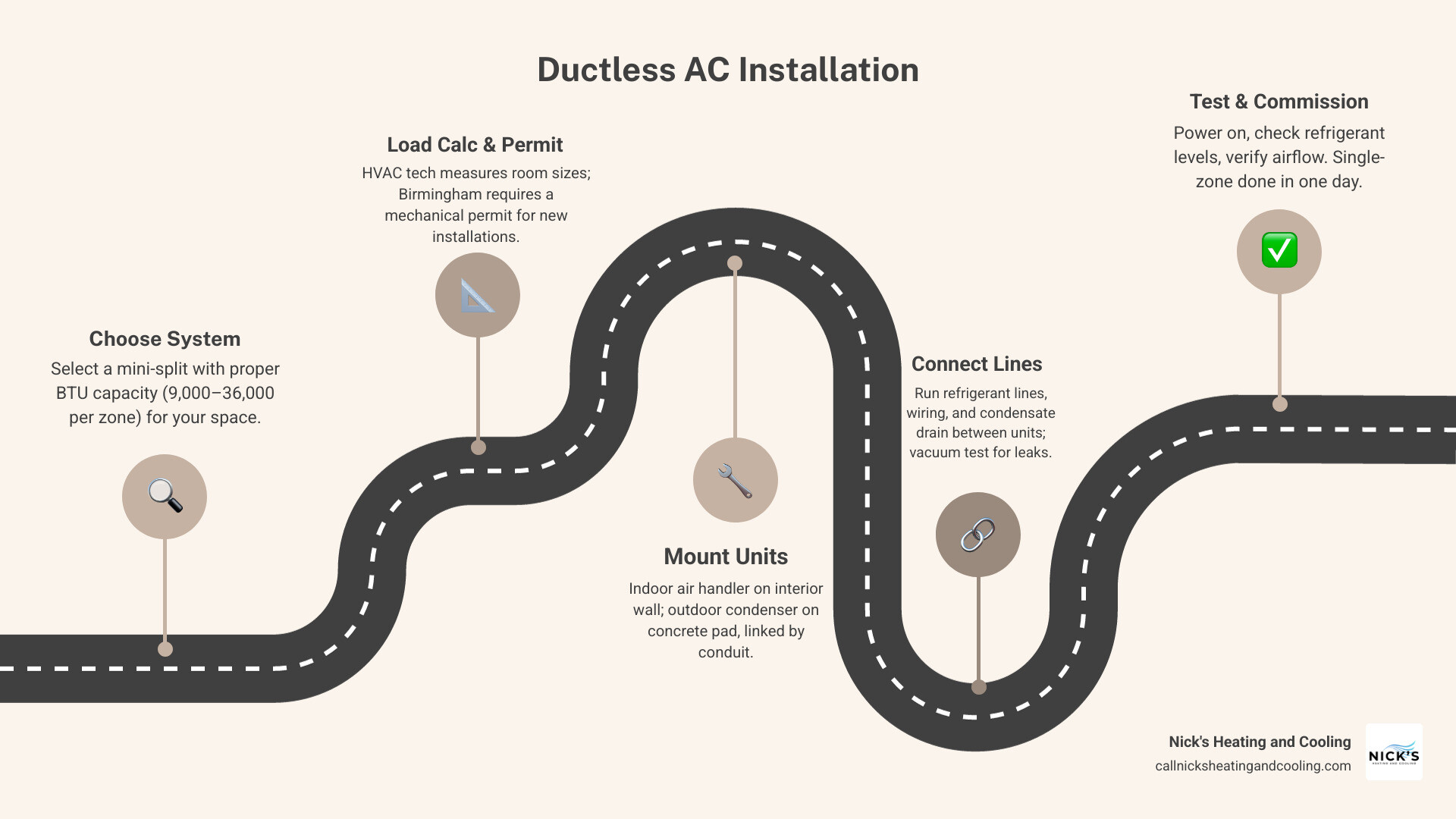
- Choose your system — Select a mini-split with the right BTU capacity for your space (typically 9,000–36,000 BTU per zone).
- Get a load calculation — A licensed HVAC tech measures your space to size the system correctly.
- Pull a permit — Birmingham requires a mechanical permit for new AC installations.
- Mount the indoor unit — The air handler is installed on an interior wall, high up for best airflow.
- Install the outdoor condenser — Placed on a concrete pad outside, connected via a small conduit through the wall.
- Run the line set — Refrigerant lines, electrical wiring, and a condensate drain connect the two units.
- Vacuum and charge the system — A tech tests for leaks, pulls a vacuum, and verifies refrigerant levels.
- Test and commission — The system is powered on and checked for proper operation.
Most single-zone installs are completed in one day. Multi-zone systems may take two days.
Birmingham summers are no joke. With heat index values regularly pushing past 100°F and humidity that makes the air feel thick, keeping your home cool is less of a luxury and more of a necessity. More Birmingham homeowners and small business owners are turning to ductless mini-split systems as a smarter, more flexible alternative to traditional central air — especially in older homes where adding ductwork is expensive or just not practical.
In this guide, Nick’s Heating and Cooling walks you through everything you need to know about ductless AC installation in Birmingham — from sizing and costs to the step-by-step installation process and ongoing maintenance.
Why Choose Ductless AC Installation in Birmingham?
Birmingham is rich with architectural history. From the historic craftsman bungalows in Forest Park and Avondale to the mid-century classics in Vestavia Hills, our local homes have character. However, what they often do not have is the structural space for bulky metal ductwork.
In the past, adding air conditioning to an older home meant sacrificing closet space, dropping ceilings, or settling for noisy, inefficient window units that block your view and invite pests. Modern ductless mini-split systems solve all of these problems at once.
When you opt for professional AC Installation, you unlock several significant benefits:
- Zoned Comfort Control: Traditional central systems use one thermostat to control the entire house. This setup inevitably leads to “hot spots”—such as a sweltering second-floor bedroom or a freezing basement. Ductless systems allow you to set different temperatures for individual rooms or “zones,” keeping everyone in the household happy.
- Lower Energy Bills: Traditional ductwork can lose up to 30% of its cooling energy through seams, cracks, and poor insulation. Because ductless systems deliver air directly into the room, they eliminate this waste entirely.
- Improved Indoor Air Quality: Dust, pollen, mold spores, and pet dander love to collect inside dark, dusty air ducts. Every time your central system kicks on, it circulates those particles. A ductless system utilizes multi-stage filtration in each individual unit, vastly improving your home’s Indoor Air Quality.
- Quiet Operation: Window units rattle and roar, making it hard to sleep or hear the television. Ductless indoor units operate so quietly (often under 20 decibels) that you will barely know they are running.
Comparing Ductless Mini-Splits to Traditional Central AC
To help you decide which path is right for your home, let us look at how these two options stack up across key categories:
| Feature | Ductless Mini-Split Systems | Traditional Central AC |
|---|---|---|
| Duct Loss | 0% (No ducts required) | Up to 30% energy loss through duct leaks |
| Installation Invasiveness | Minimal (Requires a small 3-inch wall hole) | High (Requires tearing open walls/ceilings) |
| Space Saving | High (Wall, floor, or ceiling mounted) | Low (Requires attic, basement, or closet space) |
| Zoning Capability | Built-in (Each indoor unit is its own zone) | Requires complex, expensive damper systems |
| Aesthetics | Visible indoor wall units | Invisible (Only registers/grilles are visible) |
How Birmingham’s Humid Climate Affects System Performance
Our local climate in Jefferson County presents unique challenges for cooling systems. We do not just deal with high temperatures; we deal with intense, lingering humidity.
According to Energy.gov, ductless mini-splits are exceptionally good at humidity control because they utilize variable-speed inverter compressors. While a traditional central AC system turns fully on and fully off (which can leave the air feeling damp and clammy between cycles), a ductless system runs continuously at a lower, self-adjusting speed.
This continuous operation allows the system to constantly extract moisture from the air, maintaining a comfortable relative humidity level even on the muggiest July afternoon.
Planning Your Ductless AC Installation in Birmingham
A successful ductless ac installation birmingham project relies heavily on the prep work. You cannot simply buy a unit online, mount it to the wall, and hope for the best. To get the maximum lifespan and efficiency out of your investment, you need a customized plan.
First, your technician must perform a detailed load calculation. This calculation takes into account:
- The square footage of the rooms you want to cool.
- The height of your ceilings.
- The quality and age of your home’s insulation.
- The number of windows and which direction they face (south-facing windows bring in much more heat!).
Additionally, local building codes and neighborhood guidelines must be respected. In Birmingham and Hoover, mechanical permits are required for new HVAC installations to ensure all electrical and refrigerant lines meet safety standards. If you live in a historic district or a neighborhood governed by a Homeowners Association (HOA), there may also be rules regarding where you can place the outdoor condenser unit. A professional installer will help you navigate these regulations so you avoid fines or forced relocations.
Sizing and Selecting Units for Your Birmingham Home
Sizing a mini-split is measured in BTUs (British Thermal Units). As a general rule of thumb, you need about 20 BTUs of cooling power per square foot of living space. However, high ceilings, poor insulation, or kitchen appliances can increase this requirement.
- 9,000 BTU: Ideal for small bedrooms or home offices (up to 350-400 sq. ft.).
- 12,000 BTU: Great for medium living areas or master suites (up to 500-550 sq. ft.).
- 18,000 to 24,000 BTU: Best for large, open-concept living rooms or basements (up to 1,000 sq. ft.).
You will also choose between a single-zone system (one outdoor condenser connected to one indoor air handler) and a multi-zone system (one outdoor condenser powering up to five or six indoor air handlers). Multi-zone setups are perfect for whole-home conversions, allowing you to customize temperatures across different floors.
Estimating the Cost of Ductless AC Installation in Birmingham
The cost of installing a ductless system varies based on the number of zones, the efficiency rating (SEER2), and any structural or electrical upgrades your home might need.
- Equipment Costs: A single-zone system typically ranges from $2,000 to $5,000. Multi-zone systems for an entire home can range from $6,000 to $15,000+ depending on the number of indoor units.
- Labor Rates: Professional installation in the Birmingham area requires certified HVAC technicians and electricians. Proper installation ensures your manufacturer warranty remains valid.
- Electrical Upgrades: Older Birmingham homes may have outdated electrical panels. If your panel cannot handle the added load of a new mini-split, you may need a panel upgrade, which can add to the initial cost.
- Return on Investment: While the upfront cost can be comparable to or slightly higher than a traditional system, the monthly utility savings (often 30% to 40% lower energy bills) combined with the lack of duct maintenance mean the system quickly pays for itself.
Step-by-Step Guide to the Installation Process
When you schedule your ductless ac installation birmingham project, understanding what happens on installation day can give you peace of mind. Here is a breakdown of how a professional team installs a mini-split system.
Preparing for Your Ductless AC Installation Birmingham Project
Before the installation crew arrives, you can help the process go smoothly by taking a few simple steps:
- Choose the Wall Placement: Identify where you want the indoor unit. It should be mounted high on an exterior-facing wall, away from direct sunlight or sources of heat, with at least 6 inches of open space above and on both sides.
- Clear the Outdoor Area: The outdoor condenser needs a flat, stable location. Clear away any weeds, bushes, or debris from the side of your home where the unit will sit.
- Create a Clear Pathway: Ensure the technicians have easy, safe access to both the indoor rooms and the outdoor installation site.
The Technical Steps of a Professional Installation
Once the site is ready, the technical work begins:
- Mounting the Indoor Plate: The technicians secure a heavy-duty mounting bracket to the wall studs inside your home, ensuring it is perfectly level.
- Drilling the Conduit Hole: A small, 3-inch hole is drilled through the wall at a slight downward angle. This hole allows the refrigerant lines, control wiring, and condensate drain line to pass through to the outside.
- Positioning the Outdoor Condenser: The outdoor unit is secured to a durable concrete or composite pad, or mounted on heavy-duty wall brackets to keep it elevated above dirt and leaves.
- Connecting the Line Sets: The copper refrigerant lines and electrical cables are fed through the wall hole, insulated, and connected to both the indoor and outdoor units.
- Vacuum Testing and Charging: This is the most critical step. The technician uses a specialized vacuum pump to remove air and moisture from the refrigerant lines. They then perform a pressure test to guarantee there are no leaks before releasing the refrigerant into the system.
- Finishing Touches: The hole in the wall is sealed with weatherproof foam and cosmetic line covers (called line-hide) are installed on the exterior of your home to keep the installation looking clean and professional.
Maintaining Your Mini-Split System in Alabama
To keep your new ductless system running efficiently through the scorching Alabama summers and chilly winter nights, regular maintenance is essential. Fortunately, ductless systems are incredibly easy to care for.
- Clean the Filters Every 2–4 Weeks: Unlike central AC systems where you replace a paper filter every few months, mini-splits have reusable plastic mesh filters. Simply pop open the front panel of the indoor unit, slide the filters out, rinse them in the sink, let them dry completely, and slide them back in.
- Keep the Outdoor Unit Clear: Periodically check your outdoor condenser to ensure leaves, grass clippings, weeds, or pine needles are not blocking the airflow. Keep a 2-foot clearance around the unit.
- Schedule Professional Maintenance Annually: Just like traditional systems, your ductless mini-split needs a professional check-up once a year. A technician will check refrigerant levels, inspect electrical connections, and deep-clean the indoor and outdoor coils.
If your system ever stops cooling, makes unusual noises, or leaks water down your wall, do not wait. Prompt AC Repair can prevent minor issues from turning into expensive compressor failures. Investing in regular AC Maintenance keeps your system running at peak SEER efficiency, protecting your home’s comfort and your wallet.
Frequently Asked Questions About Ductless AC
How do I find a qualified contractor for ductless ac installation birmingham?
Always look for a licensed, insured, and locally-owned Birmingham HVAC Contractor. Check for NATE (North American Technician Excellence) certification, which guarantees the technicians have undergone rigorous training. Read local reviews to ensure the company has a strong reputation for punctuality, transparent pricing, and clean work.
How long does a typical mini-split installation take?
A single-zone installation is incredibly fast and is almost always completed in just a few hours. Multi-zone systems designed to cool an entire house typically take one to two days, depending on the complexity of the line runs and electrical work.
Can ductless systems handle both heating and cooling in Birmingham?
Yes! Ductless mini-splits are heat pumps. This means they can reverse their operation to provide highly efficient heating during our mild Birmingham winters. They are far more efficient than traditional electric furnaces or space heaters, providing year-round comfort with a single system.
Conclusion
Ductless mini-split systems are an exceptional choice for Birmingham homeowners looking to slash their energy bills, gain precise temperature control, and bring modern comfort to older or historic properties.
When you are ready to explore your options, turn to Nick’s Heating and Cooling. As your trusted local HVAC professionals in Birmingham and Hoover, we provide top-tier residential and commercial services with certified technicians who prioritize integrity, professionalism, and rapid, reliable service.
We make the process completely stress-free by offering free, no-obligation inspections to help you design the perfect system for your home. Contact Nick’s Heating and Cooling today to schedule your free inspection and take the first step toward a cooler, more comfortable home!