

What Commercial Mechanical Contractors Do for Buildings
Commercial mechanical contractors install, repair, and maintain the systems that keep business buildings comfortable and usable. Their work often includes heating, cooling, ventilation, plumbing, and piping. A good contractor also considers energy use, code requirements, and how to limit disruption when equipment needs service.
For a small business in Birmingham, that may start with a simple question: Is this system worth repairing, or is it time to replace it? Nick’s Heating and Cooling offers free, no-obligation inspections for commercial HVAC needs, so you can understand the problem before deciding what to do next.
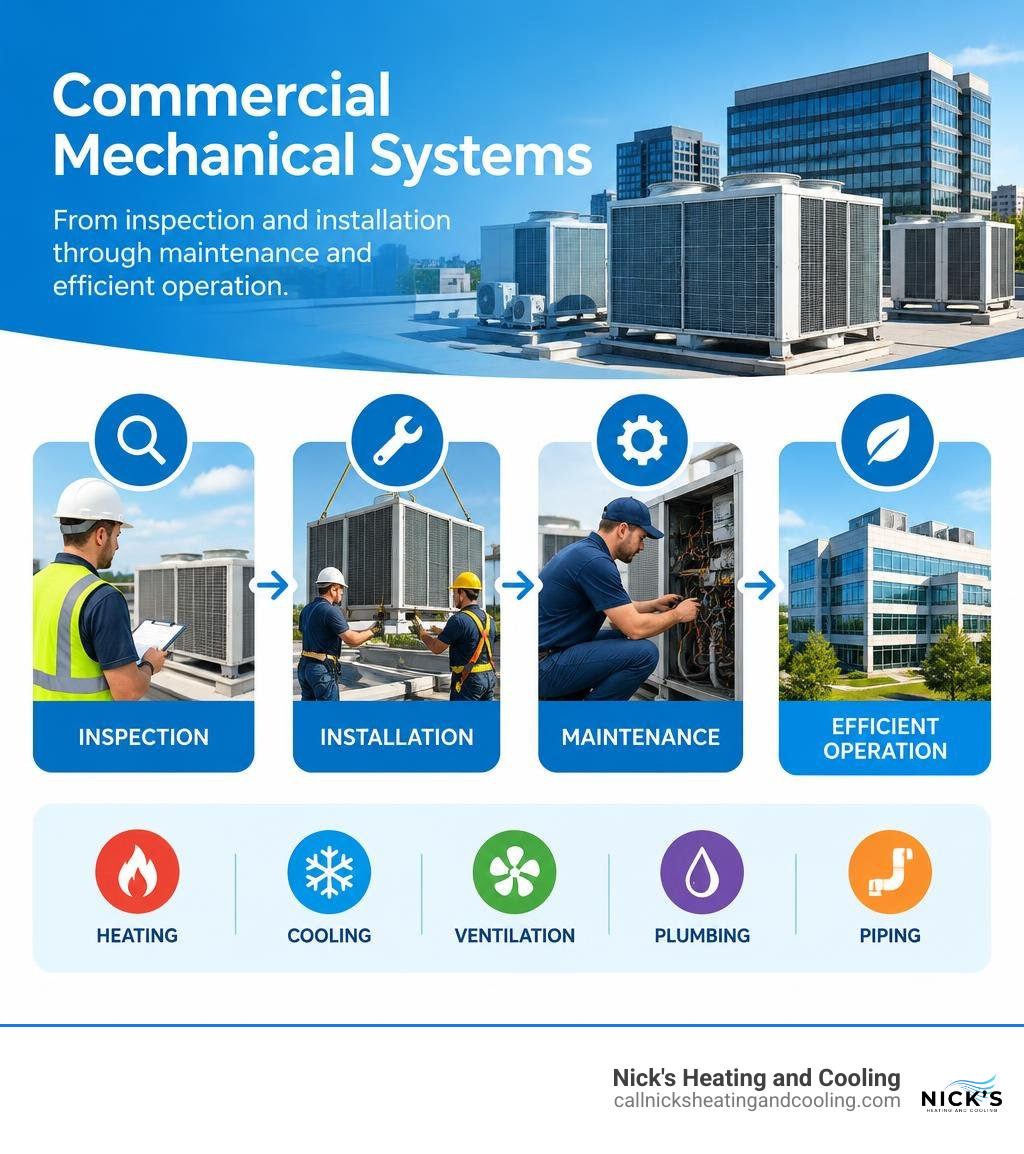
Must-know commercial mechanical contractors terms:
Core Services Delivered by Commercial Mechanical Contractors
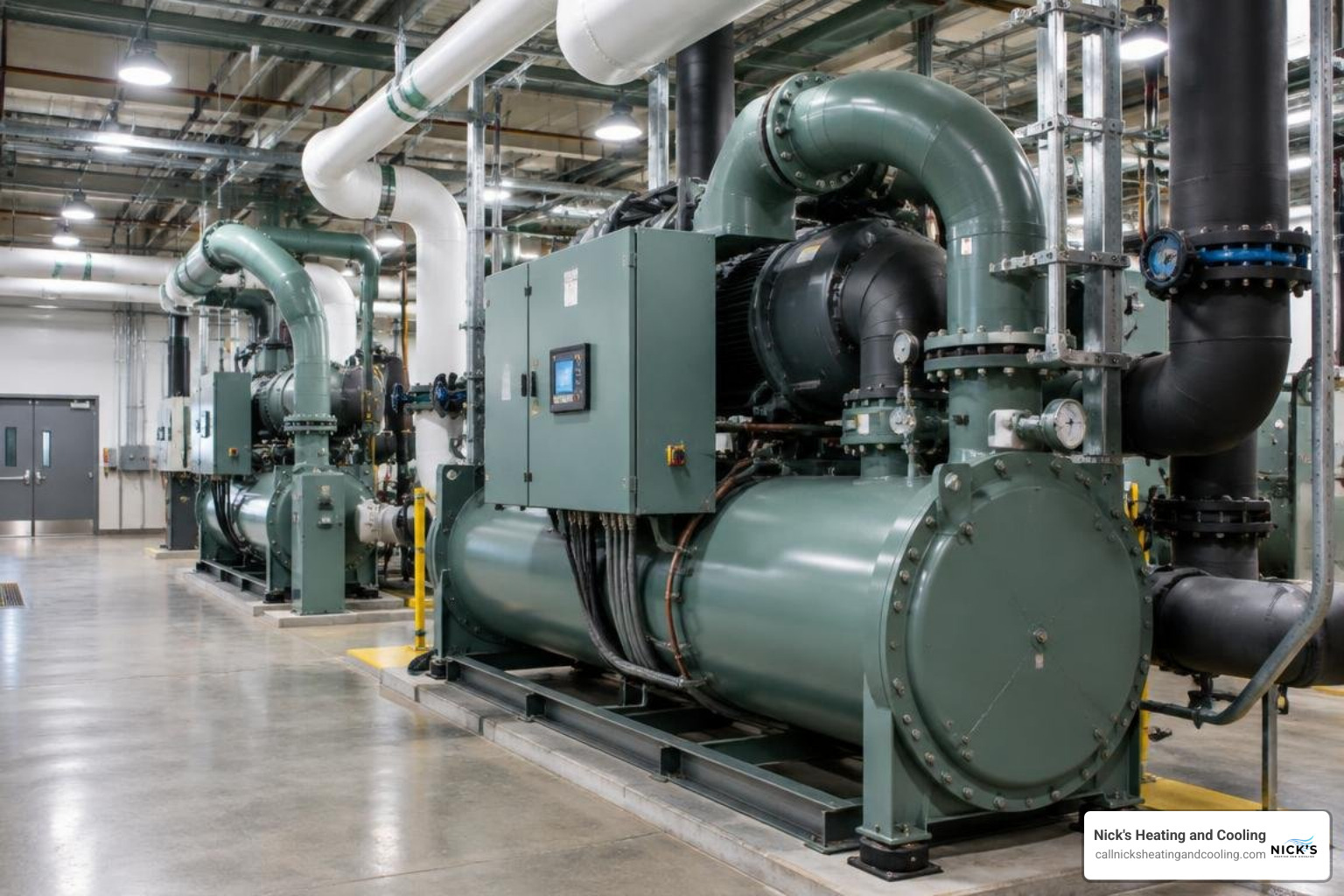
When I walk into a commercial mechanical room, I see the beating heart of a building. Commercial mechanical contractors engineer, build, and sustain the vital infrastructure that allows non-residential facilities to operate day in and day out. From central heating and cooling plants to complex hydronic networks and custom duct fabrication, these trades encompass a massive scope of work.
Understanding why quality commercial HVAC services matter for your bottom line starts with recognizing how every mechanical component interacts. When ductwork is improperly sized or ventilation air is poorly balanced, your central chillers and rooftop package units work twice as hard to maintain target setpoints. Professional mechanical construction ensures that air distribution, hydronic flow, and system controls work together seamlessly.
To maintain operational integrity, modern contractors adhere strictly to national engineering benchmarks, such as ANSI/ASHRAE/ACCA Standard 180: Standard Practice for Inspection and Maintenance of Commercial Building HVAC Systems. These standards provide rigorous frameworks for scheduled maintenance, equipment testing, and performance validation across all commercial systems.
Specialized HVAC, Piping, and Hydronic Solutions
Commercial HVAC requires far more than setting a standard condenser on a concrete pad. Mechanical contractors design, install, and service heavy-tonnage systems tailored to specific thermal zones and building architectures:
- Rooftop Units (RTUs): Packaged systems common in retail, commercial office spaces, and low-rise facilities that bundle heating, cooling, and ventilation into single outdoor cabinets.
- Chiller Plants & Cooling Towers: Water-cooled and air-cooled chillers engineered to cool large commercial properties, institutional campuses, and mission-critical sites.
- Boiler & Steam Systems: High-efficiency hydronic boilers and low- or high-pressure steam distribution systems designed for heating, domestic hot water, and industrial processes.
- Variable Refrigerant Flow (VRF): Highly efficient, multi-split systems capable of simultaneous heating and cooling across different tenant zones without massive ductwork.
- Four-Pipe Hydronic Systems: Dual piping loops (simultaneous hot water supply/return and chilled water supply/return) allowing individual spaces total temperature autonomy year-round.
- Energy Recovery Ventilators (ERVs): Systems capturing conditioned exhaust energy to pre-treat incoming outdoor fresh air, drastically reducing mechanical heating and cooling loads.
Commercial Plumbing, Medical Gas, and Utility Infrastructure
Mechanical contracting extends deep into commercial plumbing, process piping, and municipal utility connections. These operations demand exacting safety protocols and advanced fabrication techniques:
- Domestic Water & Sanitary Drainage: Heavy-duty supply lines, commercial backflow prevention devices, booster pumps, and large-scale sewer infrastructure.
- Medical Gas Piping: Certified installation of vacuum lines, medical air, nitrous oxide, and oxygen delivery systems inside healthcare clinics and surgical suites.
- Industrial Process Piping: Specialized piping networks designed to transport chemicals, compressed gases, steam, or high-pressure fluids safely.
- Rainwater Harvesting & Stormwater Control: Integrated cistern systems and greywater piping that capture and route runoff for cooling tower makeup water or site irrigation.
- Trenchless Pipe Rehabilitation: Advanced pipe-bursting and epoxy lining methods that repair underground sewer and utility mains without excavating floors or parking lots.
Evaluating Commercial vs. Residential Mechanical Scope
The mechanical scope in a commercial high-rise or warehouse is fundamentally different from a residential home. While a single-family house relies on single-phase electrical power and relatively straightforward split systems, commercial operations manage high-voltage three-phase equipment, variable thermal loads across thousands of square feet, and complex municipal codes.
| Mechanical Feature | Commercial Mechanical Contracting | Residential HVAC Services |
|---|---|---|
| System Scale & Capacity | Heavy tonnage (20 to 1,000+ tons), central plants, VRF | Typically 1.5 to 5 tons per split system |
| Power Supply | 208V, 240V, or 480V 3-phase electrical infrastructure | Standard 120V / 240V single-phase power |
| Air Distribution & Ducting | Heavy-gauge galvanized metal, variable air volume (VAV) boxes | Standard sheet metal or flex ducting with basic registers |
| Zoning & Automation | Centralized Building Automation Systems (BAS / DDC) | Single-zone or dual-zone smart thermostats |
| Regulatory Standards | Strict commercial energy codes, ASHRAE, life-safety dampers | Standard residential mechanical and energy codes |
How Commercial Mechanical Contractors Differ from Residential Specialists
Commercial mechanical contractors manage heavy equipment loads, structural engineering requirements, and intense multi-trade scheduling. They coordinate crane lifts to set multi-ton rooftop packages, calculate structural load limits with civil engineers, and synchronize their installations alongside electricians, plumbers, drywallers, and fire protection teams.
When choosing a partner for complex jobs, working with a certified HVAC contractor ensures the technicians handling your equipment understand the strict mechanical, electrical, and structural codes governing commercial spaces. Commercial systems feature complex chilled-water loops, hydronic pumps, and intricate building automation controls that require specialized engineering expertise.
Mission-Critical and Complex Facility Requirements
Certain commercial spaces cannot afford even fifteen minutes of thermal downtime or environmental fluctuation. Mechanical contractors engineer specialized, redundant systems for facilities where failure equals catastrophic financial or operational loss:
- Data Centers & Mission-Critical IT: Require Computer Room Air Handler (CRAH) units, strict N+1 or 2N equipment redundancy, hot/cold aisle containment, and precise sensible heat control to prevent server overheating.
- Healthcare Facilities & Surgical Centers: Demand precise positive and negative room pressure differentials, continuous HEPA filtration, dedicated outdoor air systems (DOAS), and strict relative humidity ranges to control infection risks.
- Cleanrooms & Laboratories: Require absolute particulate management, laminar airflow design, and constant monitoring to satisfy federal research and production guidelines.
- Industrial Manufacturing Plants: Require high-volume process exhaust, hazardous fume extraction, and heavy-duty dust collection integrated directly into the structural makeup of the facility.
Project Delivery: Design-Build vs. Plan-Spec Delivery
How a construction project is organized impacts its budget, timeline, and risk level. Commercial mechanical contracting generally follows one of two distinct delivery paths: traditional Plan-and-Spec or integrated Design-Build.
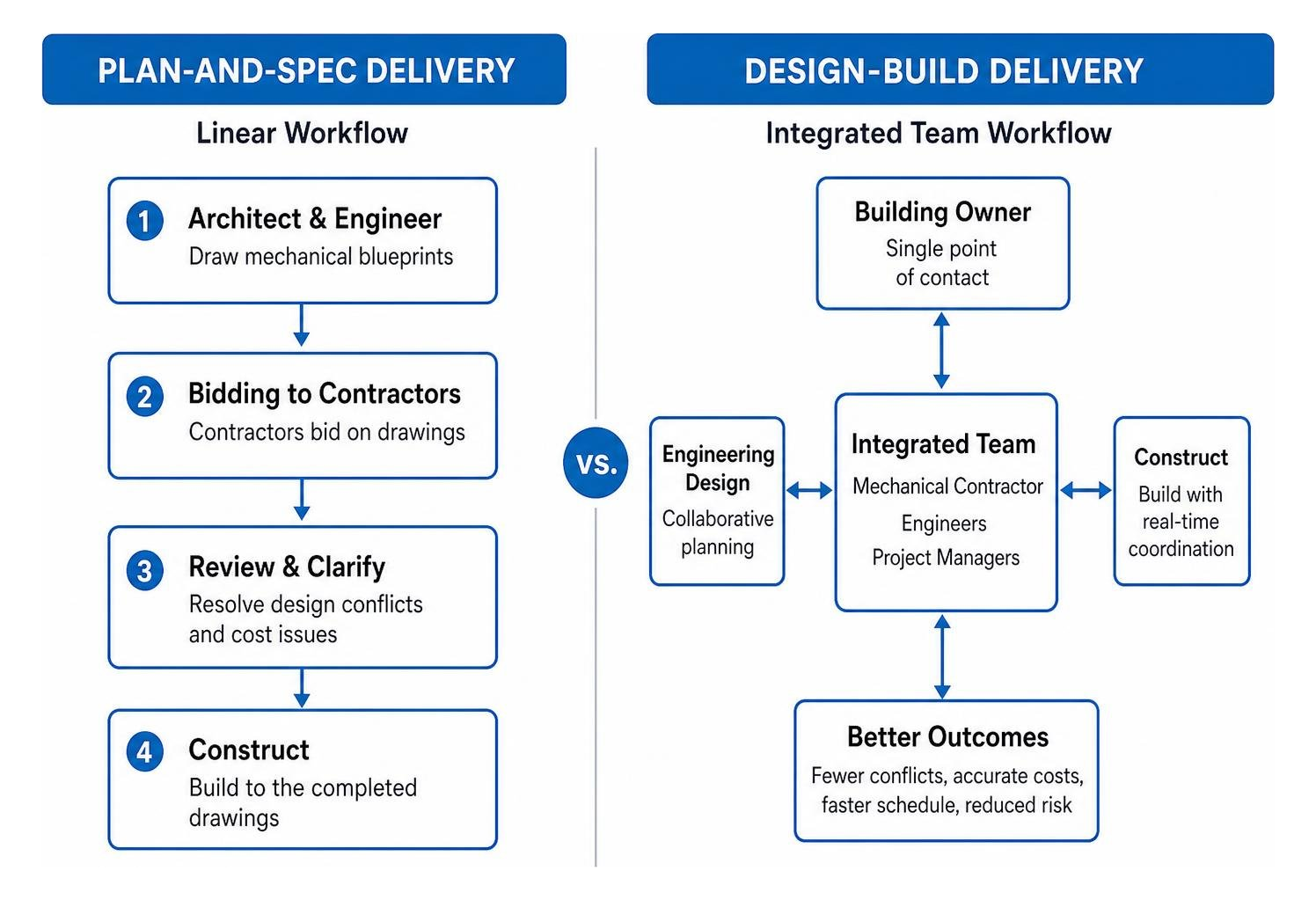
Under Plan-and-Spec, a building owner hires an independent architectural and engineering firm to draw mechanical blueprints before bidding those drawings out to contractors. This linear process can create friction if the engineering drawings contain design conflicts or if estimated equipment costs spike before bidding begins.
How Commercial Mechanical Contractors Implement Design-Build Solutions
In a Design-Build delivery method, the building owner works with a single mechanical contractor who handles both the complete engineering design and the physical construction. As an experienced team, I have seen how this single point of contact provides several practical advantages:
- Cost Certainty Early in the Process: Mechanical estimators provide real-time budget feedback during the initial conceptual phase, locking in numbers before equipment orders are finalized.
- Faster Project Timelines: Engineering and early site preparation happen at the same time. Equipment with long lead times—like custom air handlers and electrical switchgear—can be ordered months before drywall goes up.
- Fewer Friction Points: Because the engineer and the field installers work on the same unified team, potential discrepancies are resolved internally rather than through slow, expensive administrative disputes.
- Practical Value Engineering: Field-tested construction methods are built directly into the engineering drawings from day one, cutting out unnecessary design complexities that do not add value.
Mitigating Change Orders Through BIM and Value Engineering
Building Information Modeling (BIM) and 3D digital spatial scanning have transformed modern mechanical construction. Using advanced software, mechanical engineers construct a complete 3D digital model of the facility before any physical ductwork or piping is cut.
By running spatial clash detection algorithms, mechanical teams identify layout collisions between heavy duct runs, sprinkler piping, structural steel beams, and electrical conduits. Resolving these clashes digitally eliminates the mid-project field redesigns that cause budget-busting change orders. Furthermore, BIM allows contractors to prefabricate large pipe spools and duct assemblies in controlled off-site facilities, speeding up installation and improving build quality.
Maximizing Energy Efficiency and Regulatory Compliance
Operating commercial mechanical equipment is often a building’s single largest recurring utility expense. Heating, cooling, and air ventilation account for roughly 40% to 50% of the energy consumed in typical commercial real estate. Modern contractors combine smart system design, ongoing equipment balancing, and digital controls to keep utility bills manageable.
Integrating Building Management Systems and Ventilation Controls
A Building Automation System (BAS) or Direct Digital Control (DDC) network acts as the central brain of a commercial property. Instead of relying on manual thermostats scattered across different floors, a unified control network manages energy use automatically:
- Demand-Controlled Ventilation (DCV): Carbon dioxide sensors track real-time indoor occupancy, modulating outside air intake louvers to bring in fresh air only when spaces are occupied.
- Variable Frequency Drives (VFDs): VFDs vary motor speeds on fans, chillers, and pumps to match actual real-time demand rather than running full blast around the clock.
- Automated Scheduling and Night Setbacks: Systems automatically ease thermal output during off-hours while ramping up before morning staff arrivals.
- Air and Water Flow Balancing: Regular testing, adjusting, and balancing (TAB) ensures that conditioned air and hydronic water flow match original engineering specifications throughout every corner of the building.
Adapting to Modern Refrigerant Transitions and Building Codes
The mechanical sector is moving through significant regulatory updates. The phasedown of higher-GWP (Global Warming Potential) hydrofluorocarbon refrigerants—such as R-410A—has made low-GWP, mildly flammable (A2L) alternatives the new industry standard for newly manufactured equipment.
Commercial contractors ensure that modern systems are designed and vented to meet updated ASHRAE 15 and 90.1 energy efficiency standards, as well as evolving local mechanical codes. Staying compliant requires continuous technician certification, updated leak-detection sensors, and careful installation practices. Business owners evaluating local service quality can also consult top-rated regional HVAC service directories to identify well-established, highly reviewed providers in their market.
Essential Criteria for Selecting Mechanical Partners
Partnering with the right contractor protects both your capital investment and daily business continuity. An unexpected mechanical breakdown can halt production lines, spoil temperature-sensitive inventory, or leave an office tower unusable.
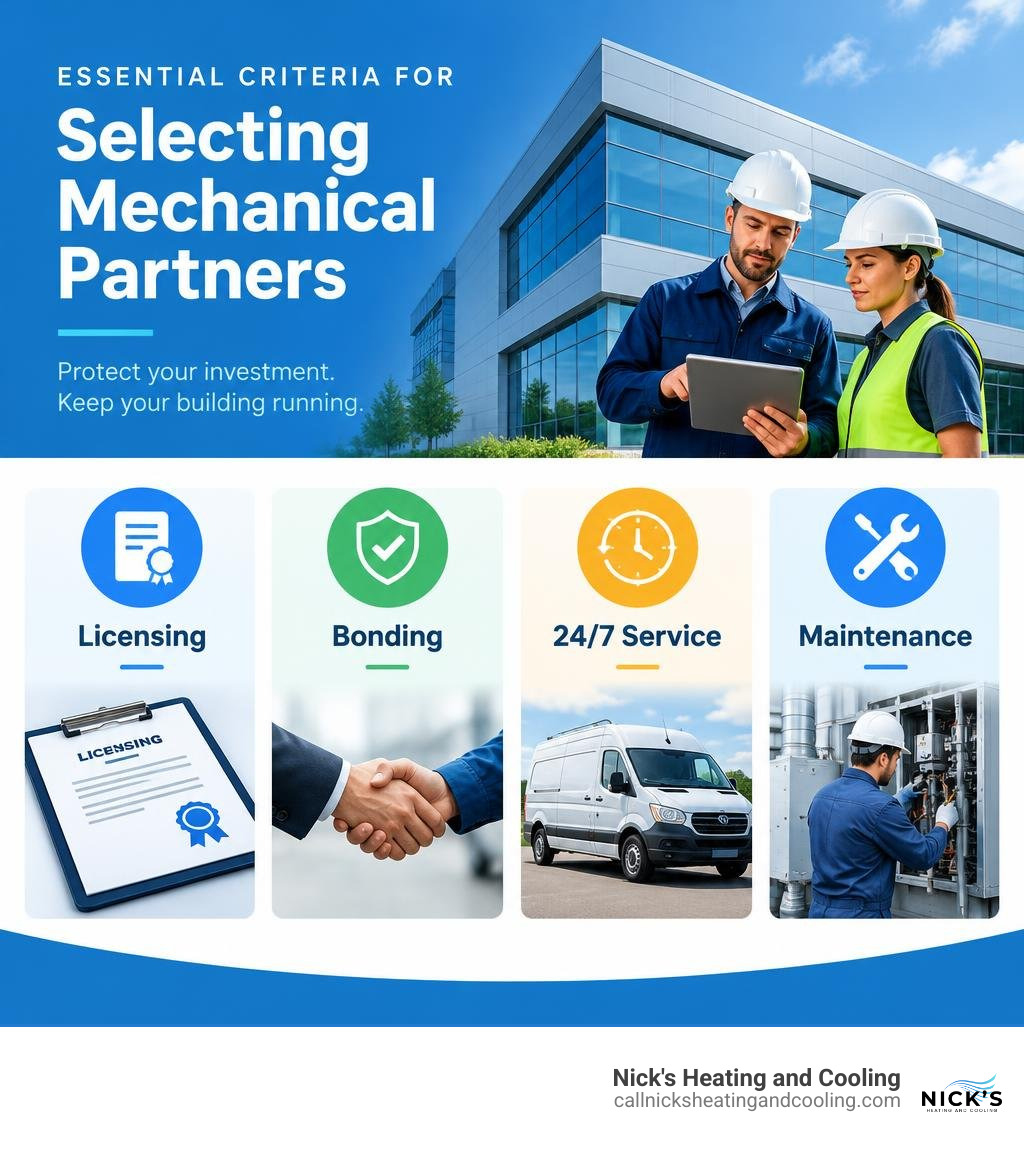
Knowing the steps for preventing commercial HVAC meltdowns gives owners a clear roadmap for proactive system health and long-term asset protection.
Verifying Licensing, Bonding, and Safety Standards
Before signing a commercial contract, confirm that your prospective team meets these essential professional benchmarks:
- Comprehensive Insurance Coverage: Verify that the contractor carries substantial Commercial General Liability, dedicated Workers’ Compensation, and multi-million-dollar Umbrella/Excess Liability policies.
- Sufficient Bonding Capacity: Robust surety bonding (bid, performance, and payment bonds) proves that the company has the financial stability to finish large-scale commercial contracts.
- Strict Safety and OSHA Records: Look for low Experience Modification Rates (EMR) and strong workplace safety policies that protect workers and property during construction.
- Valid Trade Licenses: Ensure the mechanical team holds active municipal and state HVAC, refrigeration, and plumbing licenses. If you need service in the central Alabama area, partnering with an experienced Birmingham HVAC contractor gives you direct access to certified, locally owned technicians who understand regional climate demands.
Preventive Maintenance Agreements and Emergency Response
Commercial mechanical systems run under demanding operating conditions. Equipment lifespan depends heavily on regular preventive care. Top mechanical firms structure planned maintenance agreements tailored directly to equipment age, run hours, and operating severity.
These agreements include comprehensive visual inspections, electrical amp-draw testing, bearing lubrication, belt tensioning, coil cleanings, and automated diagnostic reports. Most commercial contracts also require manufacturer-documented maintenance schedules to keep multi-year equipment warranties fully valid.
Furthermore, ensure your chosen contractor provides guaranteed 24/7 emergency dispatch with rapid response windows for critical equipment failures.
Frequently Asked Questions About Commercial Mechanical Services
What is the typical response time for commercial mechanical emergencies?
Reputable commercial contractors run severity-based dispatch queues 24 hours a day, 7 days a week. For critical emergencies involving mission-critical cooling failures, severe pipe ruptures, or heating losses in extreme winter conditions, contractors typically target an on-site arrival window of one to two hours. Priority is given to facilities with active commercial maintenance agreements.
How do mechanical contractors optimize energy efficiency in large facilities?
Contractors improve energy performance by installing Variable Frequency Drives (VFDs) on pump and blower motors, using outdoor air economizers for free cooling during mild weather, and sealing building ductwork. Integrating Direct Digital Controls (DDC) with automated setbacks and demand-controlled ventilation ensures mechanical equipment runs only when needed, significantly lowering monthly utility costs.
Why are preventative maintenance contracts necessary for commercial equipment?
Commercial HVAC and mechanical systems operate under continuous thermal and electrical loads. Skipping scheduled tune-ups leads to rapid component wear, degraded airflow, higher electrical draw, and sudden system breakdowns. Regular maintenance catches small issues before they require expensive emergency repairs, extends equipment life by years, and keeps factory warranties compliant.
Conclusion
A well-maintained mechanical system is critical to running an efficient, productive commercial building. Partnering with skilled mechanical contractors ensures that your heating, cooling, plumbing, and control infrastructure work together reliably, safely, and cost-effectively for years to come.
At Nick’s Heating and Cooling, we help business owners, property managers, and facility teams across central Alabama manage their commercial environments with confidence. From full-scale rooftop unit replacements and duct configurations to ongoing seasonal maintenance, our certified, locally owned technicians prioritize straightforward professionalism, integrity, and prompt service. We offer free, no-obligation facility inspections to help you make informed mechanical decisions that support your building’s long-term value.
Contact our team today to explore comprehensive commercial HVAC and mechanical solutions built around your facility’s unique operational needs.
Nick’s Heating and Cooling currently services Birmingham, Hoover, Vestavia Hills, Mountain Brook, Alabaster, Chelsea, Homewood, Trussville, Pelham, and Irondale for all your HVAC and Heating needs.