

When Your AC Stops Working, Here’s What You Need to Know
Air conditioning repair is the process of diagnosing and fixing problems with your cooling system — from simple issues like a clogged filter to major failures like a broken compressor.
Quick answers for Birmingham homeowners:
- AC not blowing cold air? Check your thermostat settings, air filter, and circuit breaker first.
- Hearing strange noises or smelling something musty? Call a professional — these usually need hands-on diagnosis.
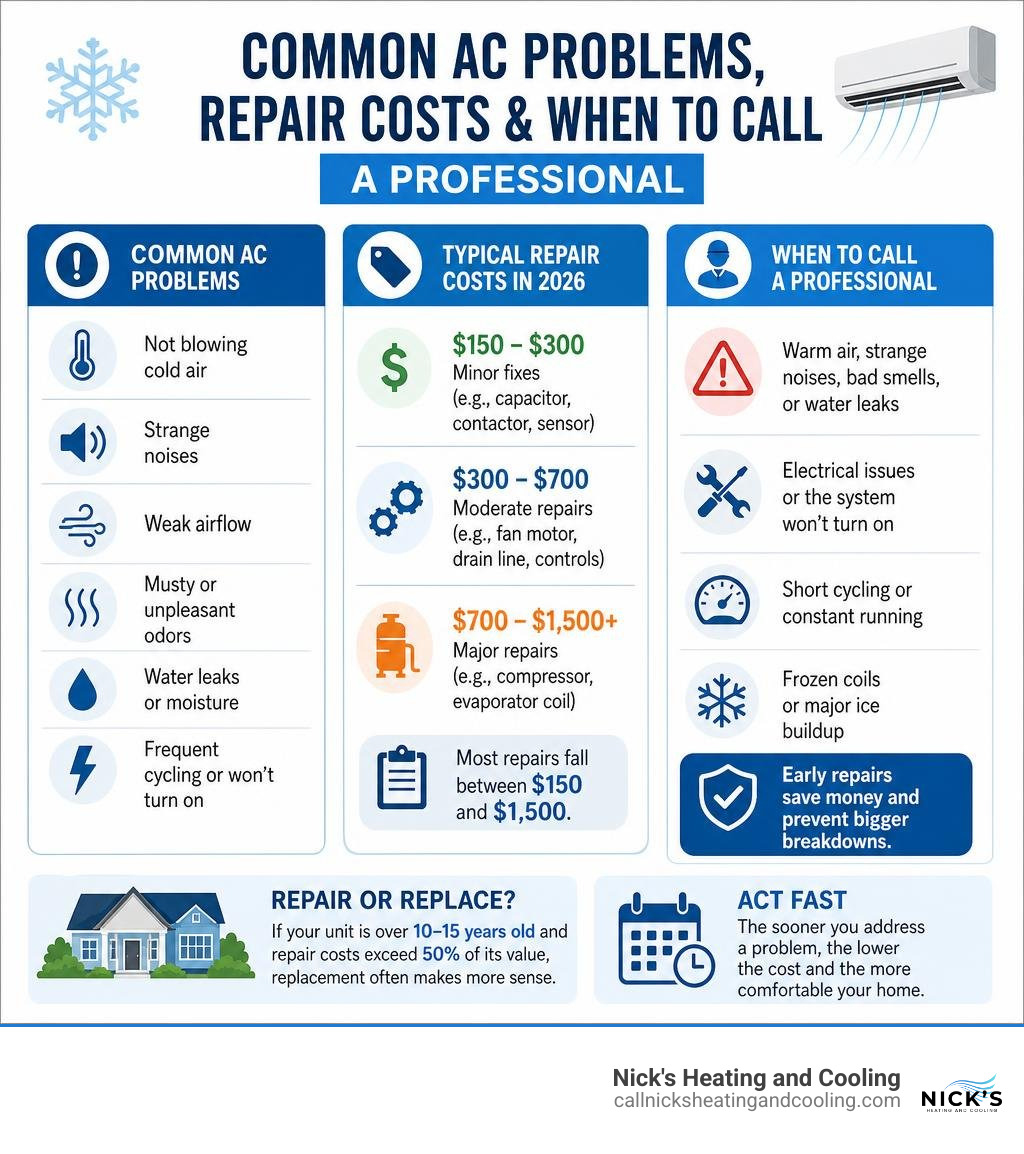
- Typical repair costs in 2026: $150 to $1,500 for most repairs; major parts like compressors can exceed that.
- Repair or replace? If your unit is over 10–15 years old and repair costs exceed 50% of its value, replacement often makes more sense.
- Need it fast? Nick’s Heating and Cooling offers emergency and same-day service across the Birmingham area.
A broken AC in a Birmingham summer isn’t just uncomfortable — it can become a health and safety issue fast. Temperatures regularly climb well above 90°F, and a system that’s struggling, short cycling, or blowing warm air will only get worse if ignored.
The good news: most AC problems are fixable, and catching them early almost always costs less than waiting for a full breakdown.
This guide walks you through everything — warning signs, DIY checks, repair costs, and how to find a trustworthy technician in your area.
When to Schedule Professional Air Conditioning Repair
When the Alabama humidity settles over Birmingham and Hoover, your home’s cooling system works overtime to keep your family comfortable. While some minor glitches can be resolved with quick DIY maintenance, most air conditioner issues require the expertise of a professional technician. Ignoring early warning signs can turn a minor, inexpensive fix into a major mechanical failure.

If you notice any of the following warning signs, it is time to schedule a professional inspection:
- Warm Air from Vents: If your thermostat is set to “cool” but your registers are blowing lukewarm or hot air, your system may have a failing compressor, a refrigerant leak, or a broken expansion valve.
- Weak Airflow: Poor airflow throughout your home means your system is struggling to circulate conditioned air. This is often caused by a failing blower motor, a severely clogged air filter, or leaky, damaged ductwork.
- Frequent Cycling (Short Cycling): Your air conditioner should run regular, consistent cycles. If it turns on and off every few minutes without actually cooling your home, it is short cycling. This puts immense strain on your compressor and spikes your energy bills.
- Strange Noises: Modern air conditioners should run relatively quietly. If you hear squealing, grinding, scraping, or loud clicking sounds, internal components like the fan blades, blower motor, or compressor are likely failing.
- Musty or Burning Odors: Musty smells coming from your vents usually point to mold or mildew growth within your ductwork or on your evaporator coils. A burning smell, on the other hand, indicates electrical issues or a motor that is overheating.
- Spiking Energy Bills: If your monthly utility bills are suddenly climbing even though your cooling habits haven’t changed, your AC is operating inefficiently. A struggling system consumes significantly more power to achieve the same temperature.
Addressing these cooling issues early prevents compounding damage. For example, ignoring a simple blower motor issue can eventually cause your compressor to overheat and fail completely. For comprehensive system diagnostic and repair options, read our More info about AC repair services.
Common Air Conditioning Repair Costs in 2026
When your cooling system breaks down, the first question on your mind is usually, “How much is this going to cost me?” In 2026, the cost of repairs to an air conditioner generally ranges from $150 to $1,500. The final price tag depends heavily on the complexity of the repair, the parts needed, and whether your system is still covered under a manufacturer’s warranty.
While minor electrical components are relatively inexpensive to replace, major mechanical components like the compressor or evaporator coil are much more costly.
To help you budget, here is a breakdown of common AC component repair costs in 2026:
| AC Component / Repair Service | Average Cost Range (2026) | Complexity Level |
|---|---|---|
| AC Capacitor Replacement | $500 | Minor / Quick |
| Contactor Replacement | $600 | Minor / Quick |
| Refrigerant Leak Repair & Recharge | $350 – $1,000 | Moderate |
| Blower Motor Replacement | $750 – $1,500 | Moderate to Major |
| Evaporator Coil Replacement | $1,500 – $2,500 | Major |
| Compressor Replacement | $3,500 – $5,000 | Major (System Heart) |
Note: These ranges represent typical industry averages in 2026. Major component replacements can sometimes exceed these estimates depending on the size and efficiency rating of your system.
What a Professional AC Repair Visit Includes
When you schedule a professional service call with us, we do not just swap out a part and leave. A high-quality repair visit is a systematic process designed to ensure your entire system is safe, efficient, and reliable.
Here is what you can expect during our professional AC repair visit:
- System Diagnostic: We begin by performing a comprehensive diagnostic of your system. This includes inspecting the thermostat communication, testing the electrical control board, and checking electrical connections.
- Voltage & Amperage Checks: Our technicians measure the electrical draw of your blower motor, condenser fan motor, and compressor to ensure they are operating within safe manufacturer parameters.
- Refrigerant Level Testing: We check your system’s refrigerant charge. Because air conditioning systems are hermetic (sealed) loops, low refrigerant always indicates a leak. We will locate the leak rather than simply “gassing and going.”
- Airflow & Temperature Split Evaluation: We measure the temperature split (the difference in temperature between the air entering the return vents and the air exiting the supply vents). A healthy system should have a split of 16 to 20 degrees Fahrenheit.
- Performance Testing: Once the repair is complete, we perform post-repair system testing. This ensures that the system cycles correctly, the condensate drain line flows freely, and your home is receiving optimal, even cooling.
DIY Troubleshooting and Common System Issues
Before you pick up the phone to call a professional technician, there are several basic troubleshooting steps you can perform yourself. Homeowners can often resolve minor airflow or power issues without paying for a professional service call.
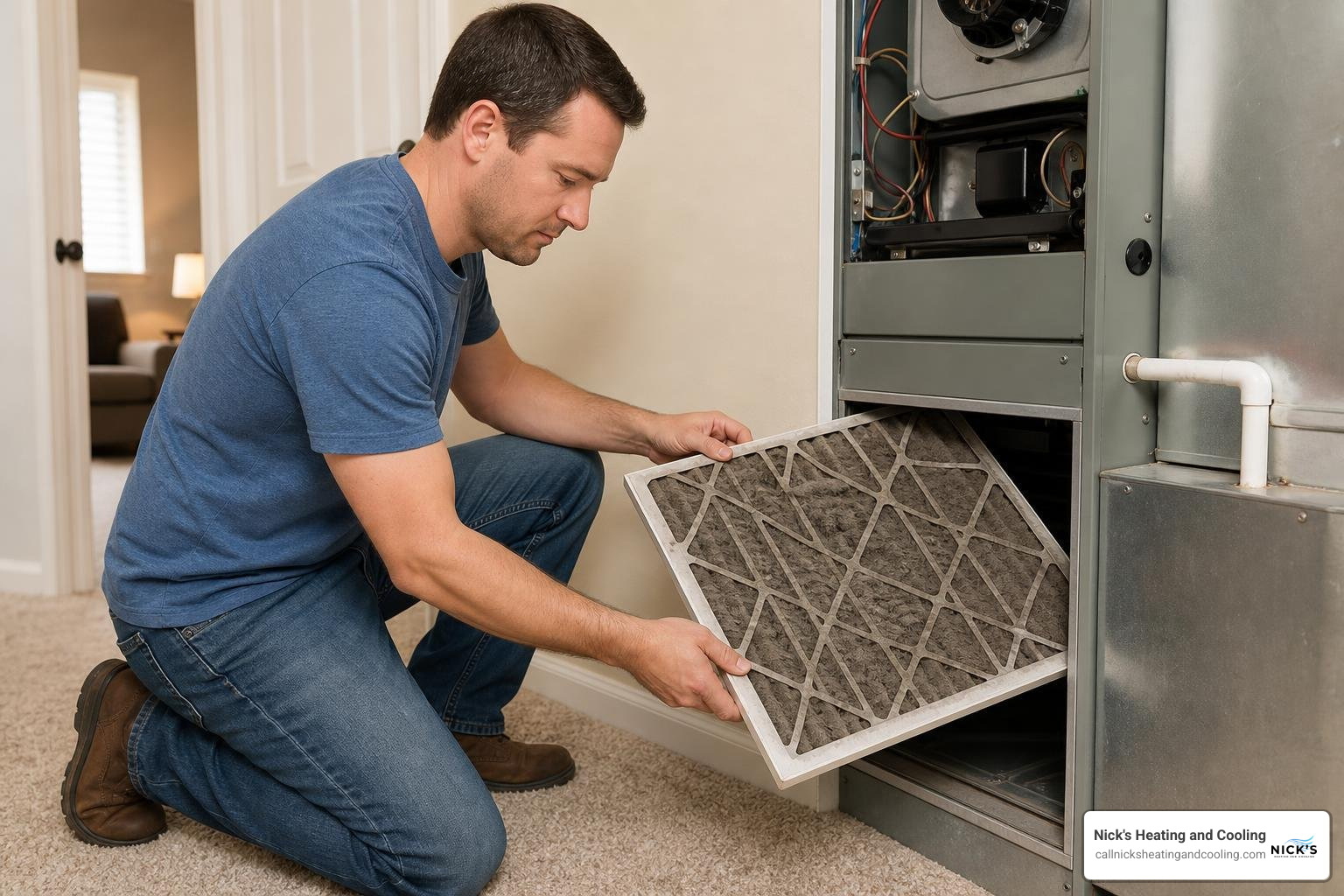
If your air conditioner is acting up, try these DIY steps:
- Check the Thermostat Settings: It sounds simple, but make sure your thermostat is actually set to “Cool” and the fan is set to “Auto” rather than “On.” If the display is blank, try replacing the batteries.
- Inspect the Circuit Breaker: If your air conditioner won’t turn on at all, locate your home’s main electrical panel. Look for the circuit breakers labeled “AC” or “HVAC.” If a breaker has tripped to the “off” position, reset it by flipping it fully off and then back on.
- Clean the Outdoor Condenser Unit: Your outdoor unit needs plenty of clearance to release heat. Turn off the power to the unit and clear away leaves, grass clippings, weeds, and debris from around the condenser. Gently rinse the outdoor coils with a garden hose if they are caked in dirt.
- Change Your Air Filter: A clogged, dirty air filter blocks airflow, forcing your system to work harder and potentially causing your evaporator coils to freeze. Replace your filter every 30 to 90 days.
If you have completed these steps and your system is still struggling, it is time to call in the professionals. Regular upkeep is the best way to prevent these issues from happening in the first place. Learn more about seasonal care with our More info about AC maintenance.
Most Common AC Problems We Fix
Over our years of serving the Birmingham and Hoover areas, we have seen and repaired every cooling issue imaginable. Some of the most common AC problems we diagnose and resolve include:
- Frozen Evaporator Coils: When airflow is restricted (usually due to a dirty filter or blocked vents) or if your refrigerant is low, the temperature of your evaporator coil can drop below freezing. This causes moisture on the coil to turn to ice, blocking all cooling.
- Clogged Condensate Drain Lines: As your air conditioner cools your home, it pulls moisture out of the air. This water drains out through a condensate line. Over time, algae and mold can clog this line, causing water to back up, overflow, and cause water damage to your ceilings or floors.
- Refrigerant Leaks: Low refrigerant leads to poor cooling performance, long cycles, and high energy bills. Because refrigerant is a chemical hazard, only EPA-certified technicians are legally permitted to locate, repair, and recharge refrigerant leaks.
- Electrical Failures: The constant starting and stopping of your AC can cause electrical contacts to pit and wear out. Capacitors, which provide the initial electrical boost to start your motors, are highly prone to failing during hot Alabama summers.
In some cases, the root cause of your cooling issue isn’t the air conditioner itself, but the ductwork distributing the air. Leaky ducts in hot attics can waste 20% to 30% of your home’s overall cooling capacity. If your ducts are crushed, leaking, or improperly sized, check out our More info about air duct repair.
Repair vs. Replace: The $5,000 Rule and Lifespan Factors
If you are facing a costly AC repair, you are probably wondering whether it is smarter to fix your current unit or invest in a brand-new system. While air conditioners can last an average of 15 years if properly maintained, their efficiency declines as they age.
Several factors should influence your decision to repair or replace:
- System Age: If your air conditioner is over 10 to 12 years old, it is nearing the end of its reliable operational lifespan. Modern units must comply with strict SEER2 energy-efficiency standards, meaning a new system will immediately lower your monthly power bills.
- Refrigerant Type (R-22 Phaseout): If your unit was installed before 2010, it likely uses R-22 refrigerant (commonly known as Freon). R-22 has been phased out due to environmental regulations. Repairing a leak on an R-22 system is incredibly expensive because the refrigerant is no longer manufactured, making replacement the far more practical choice.
- Frequency of Breakdowns: If you are calling a technician every summer for a new repair, those individual bills will quickly add up to the cost of a new system.
If your system is constantly breaking down or keeping your home humid, it might be time to look at your upgrade options. Discover our replacement and installation services by reading our More info about AC installation.
The $5,000 Rule and the 50% Threshold
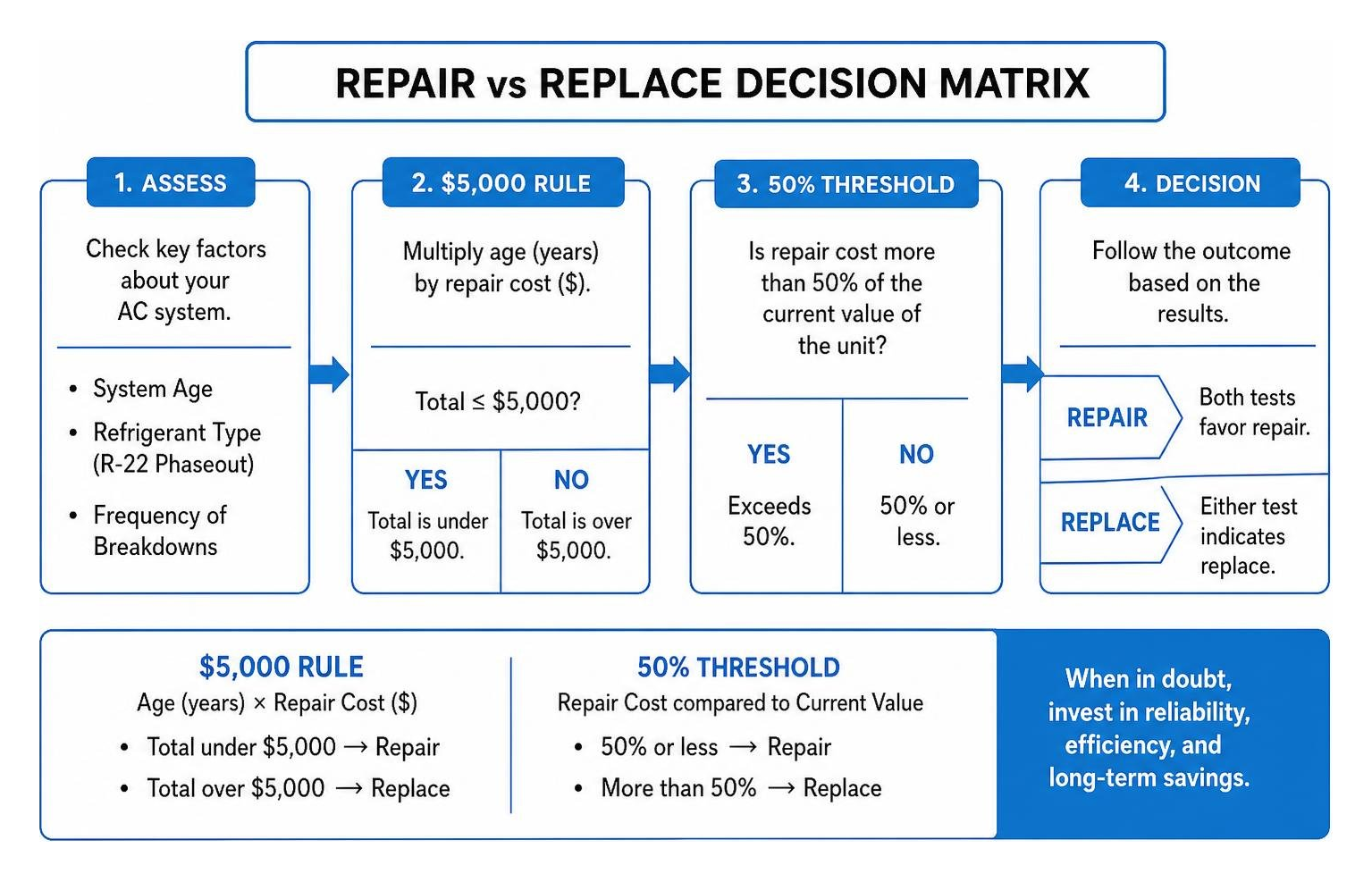
To take the guesswork out of the repair-versus-replace dilemma, HVAC professionals rely on two straightforward guidelines: the $5,000 Rule and the 50% Threshold.
The $5,000 Rule is a simple mathematical formula:
Multiply the age of your unit (in years) by the estimated repair cost ($).
If the total is under $5,000, repairing the unit is usually a safe bet. If the total exceeds $5,000, that money is better spent as a down payment on a new, energy-efficient system.
- Example A: A 5-year-old system needs a $500 capacitor repair. (5 x 500 = $2,500). Repair it.
- Example B: An 11-year-old system needs a $600 repair. (11 x 600 = $6,600). Replace it.
Additionally, consider the 50% Threshold: If the cost of the repair exceeds 50% of the current operating value of the unit, you should opt for an AC replacement instead of a temporary fix.
How to Choose the Right Air Conditioning Repair Company
Your heating and cooling system is one of the most expensive mechanical investments in your home. When it needs service, you should only trust certified, local professionals.
While homeowners in other parts of the country might look for local services—such as those seeking AC repair in Sacramento, CA, AC repair in NYC, or air conditioning repair in Miami, FL—our focus is entirely on providing top-tier service to our neighbors here in Central Alabama.
When choosing an HVAC partner, look for the following credentials:
- EPA Section 608 Certification: This is legally required for any technician handling refrigerant.
- Licensed, Bonded, and Insured: This protects your home and family in the event of an accidental injury or property damage during a repair.
- Transparent, Flat-Rate Pricing: Avoid companies that charge by the hour or give vague, open-ended estimates. You should receive a clear, written quote before any work begins.
- Local Ownership and Reviews: A locally owned company has a vested interest in keeping the community comfortable and maintaining a stellar local reputation.
Beyond temperature control, your HVAC system plays a massive role in filtering out dust, pollen, and humidity from your indoor air. If you want to make your home healthier and cleaner, read our More info about indoor air quality.
Frequently Asked Questions About AC Service
How long does an AC repair usually take?
The duration of an AC repair depends on the complexity of the issue. Minor repairs—such as replacing a capacitor, contactor, thermostat, or clearing a clogged condensate drain line—typically take 1 to 2 hours to complete.
Moderate repairs, like replacing a fan motor or fixing a minor refrigerant leak, can take 2 to 4 hours. Major repairs, such as replacing a compressor or an entire evaporator coil, are more labor-intensive and usually take 4 to 6 hours or more. Our technicians carry fully stocked service vehicles to ensure we can complete most repairs on-the-spot during our very first visit.
Do you offer emergency or same-day AC repair service?
Yes! We know that an AC breakdown during a humid Alabama summer is more than just an inconvenience—it can quickly become a safety hazard for children, elderly family members, and pets.
We offer rapid-response emergency dispatch and same-day AC repair services across Birmingham and Hoover, AL. Our phones are answered 24/7, and our technicians are always standing by to restore safety and comfort to your household.
What brands of air conditioners do you service?
We service and repair all major manufacturer brands of air conditioners, heat pumps, and ductless mini-split systems. Whether your home has a Trane, Carrier, Lennox, Rheem, Ruud, Goodman, York, Amana, or Bryant system, our certified technicians have the training, diagnostic tools, and high-quality OEM (Original Equipment Manufacturer) parts to get the job done right.
Conclusion
At Nick’s Heating and Cooling, we believe that every homeowner in Birmingham and Hoover, AL deserves honest, reliable, and professional service. We are proud to be locally owned and operated, and we stand by our work with certified technicians who prioritize integrity and professionalism.
We make getting help easy by offering free, no-obligation inspections on system repairs and replacements. We will diagnose your cooling system, explain the issue in plain language, and provide a transparent, upfront quote with absolutely no hidden fees.
Do not suffer through the Alabama heat with a struggling or broken air conditioner. Schedule your professional AC repair service today!