

What Air Duct Installation Really Costs — and What the Process Involves
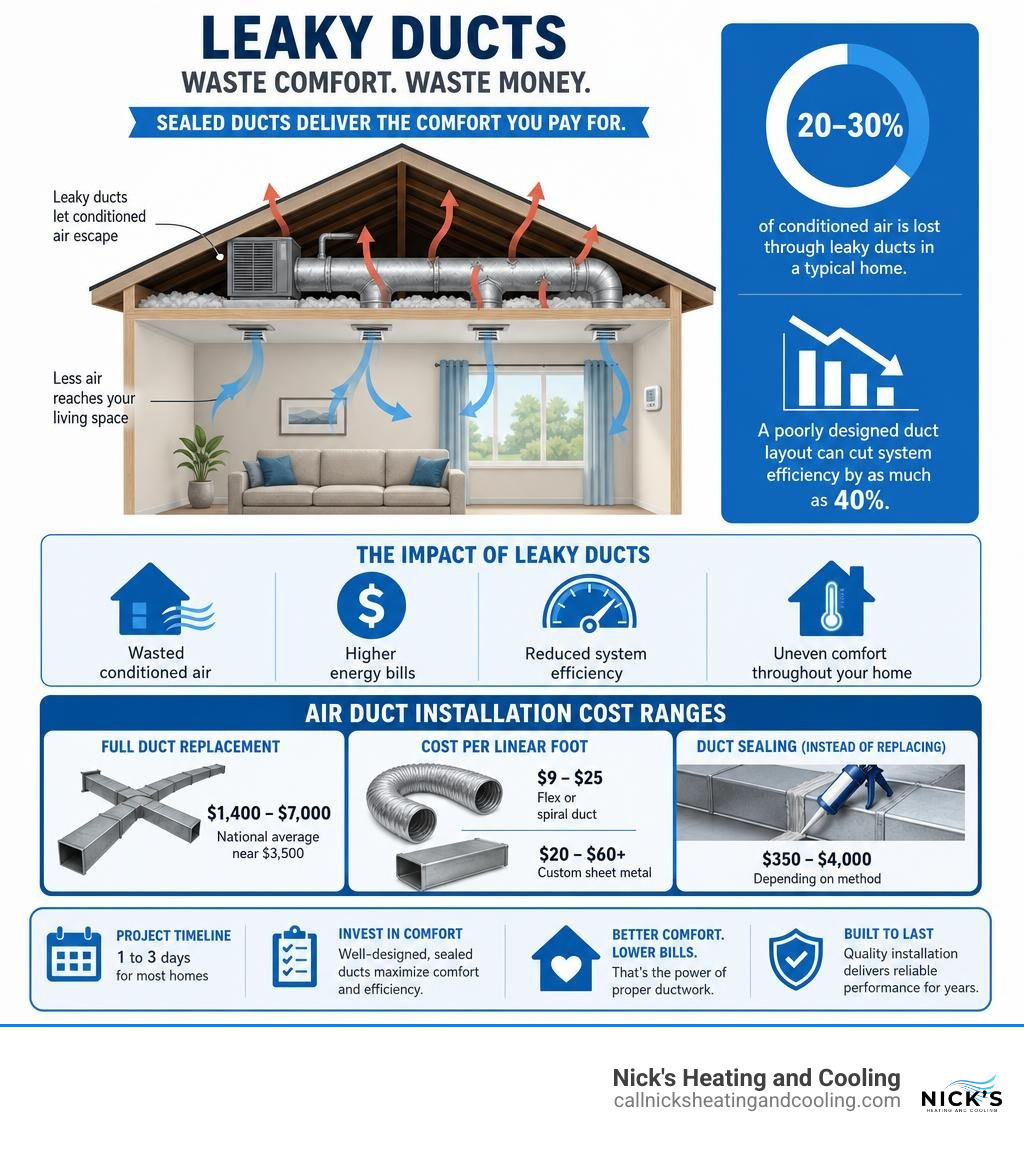
Air duct installation is the process of adding, replacing, or rerouting the system of channels that carry heated or cooled air through your home. Here is a quick snapshot of what most Birmingham homeowners need to know:
At a glance:
- Average cost: $1,400 to $7,000 for a full replacement (national average near $3,500)
- Cost per linear foot: $9–$25 for flex or spiral duct; $20–$60+ for custom sheet metal
- Project timeline: 1 to 3 days for most homes
- Duct sealing (instead of replacing): $350–$4,000 depending on method
- Tax credits in 2026: None — federal duct credits expired after December 31, 2025
Most homeowners only think about their ductwork when something goes wrong — a room that never gets comfortable, an energy bill that keeps climbing, or a whistling sound every time the system kicks on. But the ducts are doing critical work every single day. The Department of Energy estimates that 20 to 30 percent of conditioned air is lost through leaky ducts in a typical home. That is money leaving your house through the walls, attic, or crawlspace before it ever reaches you.
A poorly designed duct layout can make that problem even worse — cutting system efficiency by as much as 40 percent.
This guide walks you through everything: how to spot duct problems, what materials work best, what it costs in 2026, and exactly what a professional installation involves from the first inspection to the final airflow test.
What is Air Duct Installation and When is it Necessary?
Your home’s HVAC system is only as good as its delivery network. Think of your air conditioner and furnace as the heart of your home’s comfort, and the ductwork as the circulatory system. If the pathways are clogged, narrow, or leaking, it does not matter how powerful or efficient your heating and cooling equipment is. In fact, ductwork cannot outwork a clogged filter or a poor layout any more than a marathon runner can perform while breathing through a straw.
An air duct installation is the physical layout, connection, and sealing of these pathways. It becomes necessary in several key scenarios:
- New Construction & Home Additions: When building a new home or adding a room (like a bonus room over the garage), new duct runs must be designed and integrated into the structure.
- HVAC System Upgrades: Modern high-efficiency heat pumps and variable-speed air handlers move air differently than older systems. If you hook a high-tech system up to old, undersized ductwork, you risk strangling the system, which can cause premature blower motor failure.
- Aging Infrastructure: Over time, the materials holding your ducts together degrade. In our hot, humid Birmingham summers, attic heat can destroy duct tape adhesive, break down insulation, and cause flexible ducts to sag.
- Correcting Builder Errors: Many tract homes are built with speed in mind rather than custom airflow engineering, leaving certain rooms permanently uncomfortable.
When you invest in professional air duct installation, you are restoring the proper balance of air pressure and temperature throughout your entire living space.
Signs You Need a New Air Duct Installation
Because ductwork is mostly hidden behind drywall, in attics, or under crawlspaces, issues can hide for years. However, your home will drop several hints that it is time to look closer:
- Uneven Room Temperatures: If you find yourself constantly adjusting your thermostat like it is a TV remote because the living room is freezing while the back bedrooms are sweltering, your ducts are likely failing to distribute air evenly.
- Weak Airflow: When you hold your hand up to a supply vent, the air should feel like a steady, firm breeze. If it feels like a weak whisper, you likely have disconnected or crushed duct runs.
- Whistling, Popping, or Rattling Noises: Poorly fitted metal ducts can shake, pop, or create oil-canning sounds when pressure changes. A loud whistling noise usually indicates that air is being forced through a gap that is too small or that the system is starved for return air.
- Excessive Dust Accumulation: If you dust your shelves only to find a thick gray layer returning a day later, your return ducts may have a leak. This creates a “venturi effect,” actively sucking in attic dust, insulation fibers, and crawlspace dirt and blowing it directly into your breathing air.
- Spiking Utility Bills: If your energy costs are rising but your heating and cooling habits haven’t changed, your system is working overtime to compensate for air escaping into unconditioned spaces.
Repair vs. Partial vs. Full Replacement
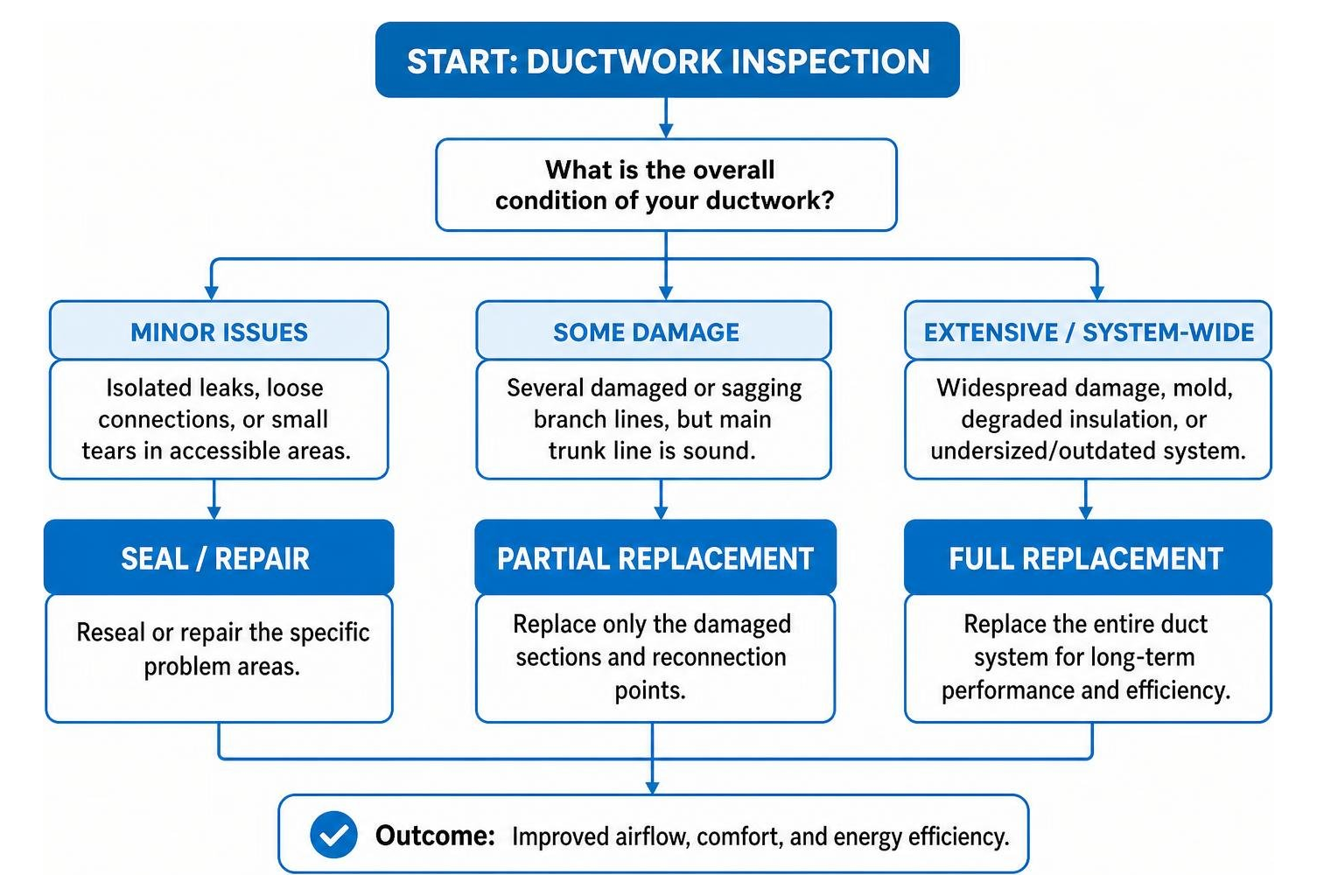
When we inspect a home’s duct system, we do not automatically assume you need a complete replacement. We look at the scope of the damage and categorize the solution into three tiers:
- Targeted Repair: This is best for minor issues, such as a single disconnected joint in an accessible attic space, or a small tear in a flexible duct run. We can quickly reseal these joints using professional mastic sealant or UL 181-rated foil tape. To learn more about these quick fixes, check out our air duct repair services.
- Partial Replacement: Often, the main trunk line of a home (the large central metal duct) is in perfectly good shape, but the branch lines (the smaller ducts running to individual rooms) are sagging, kinked, or chewed through by pests. In this case, we replace only the damaged runs and rebuild the transitions.
- Full Replacement: If your system is over 20 to 25 years old, heavily contaminated with mold, insulated with degraded materials, or fundamentally undersized for your new HVAC unit, a complete replacement is the most cost-effective long-term move.
Comparing Ductwork Materials, Lifespan, and Efficiency
Choosing the right material for your air duct installation directly impacts how long the system will last, how quiet it will be, and how much energy it will save.
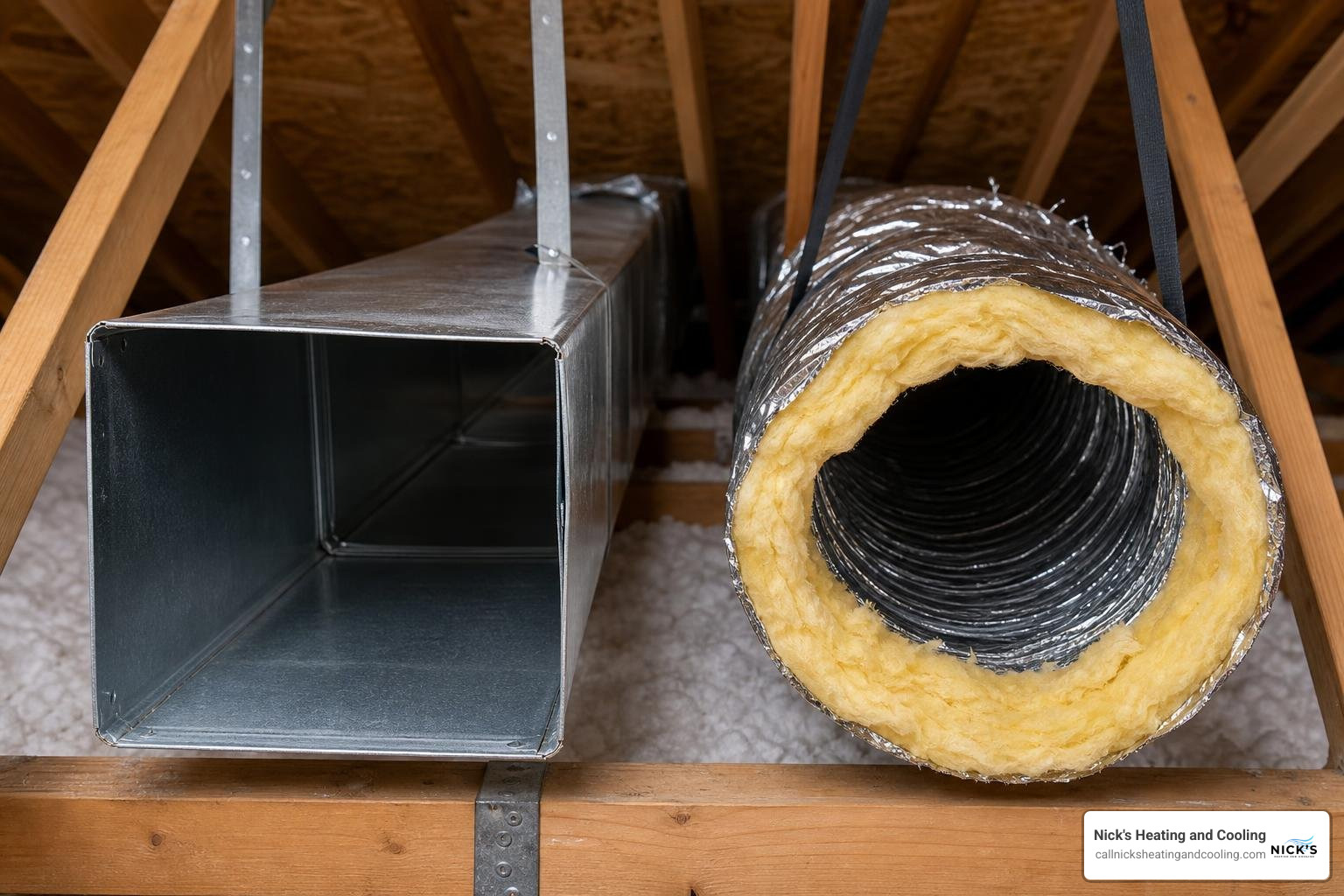
Every material has its place in residential HVAC design, and a high-quality system often uses a combination of different types to balance performance and cost.
Sheet Metal vs. Flex Duct vs. Duct Board
Here is how the three most common residential duct materials stack up against one another:
| Material Type | Average Lifespan | Pros | Cons | Best Used For |
|---|---|---|---|---|
| Galvanized Sheet Metal | 30+ Years | Highly durable; smooth interior for maximum airflow; easiest to clean; mold-resistant. | Higher upfront cost; requires custom fabrication; can transmit noise if not insulated. | Main trunk lines, plenums, and high-velocity systems. |
| Flexible Duct (Flex) | 15 to 25 Years | Affordable; fast to install; built-in insulation; naturally quiet. | Easy to kink or crush; vulnerable to pest damage; higher airflow resistance if not pulled tight. | Branch runs connecting the main trunk line to individual registers. |
| Fiberglass Duct Board | 15 to 20 Years | Excellent built-in thermal insulation; naturally dampens system noise. | Interior fiberglass can degrade; hard to clean; highly vulnerable to moisture and mold in humid climates. | Short transition pieces, plenums, and low-velocity systems. |
While some contractors might try to install an entire system out of cheap flex duct, professional ductwork installation standards dictate that rigid sheet metal should be used for the main trunk line to maintain static pressure. Flex duct should be reserved for short, straight branch runs—ideally limited to 5 to 15 feet—and must be supported every 4 feet to prevent sagging, which can choke airflow like a bent drinking straw.
Safety Risks of Damaged or Wet Ducts
Ductwork that is damaged, torn, or exposed to moisture is more than just an efficiency drain—it can become a serious health and safety hazard.
In our humid Birmingham and Hoover climate, “sweating” ducts are a common issue. When cold air blows through uninsulated or poorly insulated ducts running through a hot attic, condensation forms on the outside of the duct. If this moisture pools, it creates a breeding ground for mold and mildew. When the HVAC blower kicks on, these mold spores are distributed throughout your home, severely degrading your indoor air quality.
Furthermore, torn ducts in crawlspaces or attics invite pests like rodents and insects, who leave behind droppings and nesting materials. If you suspect your ducts have been compromised or are filled with years of debris, you may want to look into professional air duct cleaning to clear out contaminants before making major structural changes.
Finally, leaky return ducts located near gas-burning appliances (like a gas water heater or furnace) can create a dangerous draft issue. By pulling air from the utility closet, they can cause combustion gases—including carbon monoxide—to backdraft into your home instead of venting safely outside.
The Cost of Air Duct Replacement in 2026
If you are planning your budget for 2026, understanding how ductwork is priced can help you avoid surprises.
Most homeowners pay between $1,400 and $7,000 for a full duct replacement, with the national average sitting right around $3,500. For a detailed breakdown of these costs, you can read the comprehensive Air Duct Replacement Cost in 2026: By Foot, By Home Size, and When to Seal Instead | Home Energy Decisions guide.
By the linear foot, you can expect the following pricing ranges:
- Flexible or Spiral Duct: $9 to $25 per linear foot (installed).
- Custom Sheet Metal: $20 to $60+ per linear foot (installed).
Labor is a massive component of this pricing, typically accounting for 40% to 60% of the total bill. This is because retrofitting ducts in an existing home is physically demanding work that requires squeezing into tight attics or damp crawlspaces, carefully dismantling old systems, and hauling away waste. In fact, replacing existing ducts costs about 25% more than installing them in new construction due to the demolition and disposal labor involved.
Cost Factors: Sizing, Layout, and Accessibility
No two homes are priced exactly the same. Several key factors will drive your final estimate up or down:
- Accessibility: If your home has a wide-open attic with high ceilings, the job is straightforward and fast. If your ducts are run through a tight, low-clearance crawlspace or require cutting through drywall chases in a multi-story home, labor hours will rise quickly.
- Home Size & Number of Zones: A 1,200-square-foot ranch home requires significantly less material and design time than a 3,500-square-foot two-story home with multiple heating and cooling zones.
- Custom Plenums and Transitions: Connecting new ductwork to an existing air handler often requires custom-fabricated sheet metal plenums. These must be hand-crafted by skilled technicians to ensure a perfect, airtight fit.
Should You Seal or Replace Your Ducts?
Before you commit to a full duct replacement, it is worth asking if a professional sealing job could solve your issues for a fraction of the price.
If your ducts are structurally sound, properly sized, and free of mold, professional sealing is almost always the smarter, more economical choice.
- Manual Mastic Sealing: Costs about $350 to $1,000. A technician crawls through your attic or crawlspace, manually applying a thick, paste-like mastic sealant to all accessible joints and seams.
- Internal Aerosol Sealing (such as Aeroseal): Costs about $1,500 to $4,000. The system is pressurized, and a specialized aerosolized sealant is blown through the ducts. The particles automatically stick to and seal leaks from the inside out, reducing leakage by up to 95%.
If your ducts are crushed, rotting, or severely undersized, sealing them is like putting a band-aid on a broken bone. In those cases, a full or partial replacement is necessary.
Tax Credits and Rebates in 2026
We have some important news for homeowners planning their projects for this year: Federal tax credits for standalone ductwork expired on December 31, 2025.
Under the old 25C tax credits, duct sealing and replacement could occasionally qualify for minor incentives when paired with a complete heat pump installation. As of July 2026, those specific federal tax credits are no longer active for standalone duct projects.
However, you can still find savings through local utility rebates. Many power and gas companies in the Birmingham area offer rebates for professional duct sealing and insulation upgrades because they directly reduce grid strain during peak summer and winter months. We always recommend checking with your local energy provider before starting a project to see what incentives are currently active.
The Step-by-Step Professional Installation Process
When you hire a licensed professional, air duct installation is treated as a precise science rather than a simple plumbing project. Air behaves according to the laws of fluid dynamics, and a great installation respects those physics.
Manual J and Manual D Sizing
Every great duct system starts on a computer, not in the attic. To design a system that works, we use two industry-standard protocols published by the ACCA:
- Manual J (Load Calculation): This determines exactly how much heating and cooling (measured in BTUs or tons) each individual room in your home needs. It accounts for square footage, window sizes, insulation quality, local Birmingham climate data, and home orientation.
- Manual D (Duct Design): Once we know how much air each room needs, Manual D is used to calculate the physical size, shape, and routing of the ducts. This balances friction loss against the static pressure capabilities of your HVAC blower motor.
If your ducts are designed without these calculations, you risk major system issues. Undersized ducts force your blower motor to work twice as hard, leading to premature mechanical failure, while oversized ducts cause air to lose velocity, resulting in stagnant dead zones. For a deeper look into these engineering standards, read the technical breakdown on HVAC Duct Installation: Materials, Sizing and 2026 July 🧠.
What to Expect During Your Air Duct Installation
A typical whole-home duct replacement takes 1 to 3 days and follows a structured sequence:
- Step 1: Visual Inspection & Work Plan: Technicians review the engineered design, locate all current duct runs, and prep the work areas with drop cloths to protect your flooring.
- Step 2: Demolition & Removal: The old, inefficient ductwork is carefully disconnected, cut into manageable pieces, bagged, and removed from your home.
- Step 3: Framing & Hanging Trunk Lines: The new rigid sheet metal trunk lines are hung from joists using heavy-duty support brackets and vibration-isolation connectors to prevent rattling.
- Step 4: Running Branch Lines: Flexible branch runs are pulled tight (to minimize friction loss) and connected to the main trunk line using start collars and mechanical fasteners.
- Step 5: Sealing & Insulating: Every joint is sealed with professional mastic. Supply ducts in unconditioned spaces (like attics) are wrapped in insulation meeting the 2024 IECC building code of R-8 insulation, while interior ducts in conditioned spaces use R-6 insulation.
- Step 6: Balancing & Testing: We perform a duct-blaster pressure test to ensure total leakage is under the industry-standard target of 12% for retrofits. Finally, we use flow hoods to balance the air velocity at every register.
DIY vs. Professional HVAC Installation
It can be tempting to treat ductwork as a weekend DIY project. After all, you can buy flexible duct and foil tape at any home improvement store. However, we strongly advise against this for several reasons:
- The Math is Hard: Sizing ducts by “what fits in the crawlspace” instead of using Manual D calculations often leads to system imbalance, loud whistling noises, and frozen AC coils.
- Code Compliance: Building codes in Birmingham and Hoover require specific R-values, fire-rated materials, and documented pressure testing. A DIY job rarely passes official municipal inspections.
- Specialized Tools: Professional installations require expensive, calibrated tools like manometers to measure static pressure, sheet metal crimpers, and duct-testing equipment.
- System Longevity: Improperly installed ducts can cut the lifespan of your expensive heat pump or air conditioner in half.
If you want to keep your current system running at its best, investing in professional installation is the safest route. If your system is older, you might also want to pair your duct project with a professional AC maintenance visit to ensure your entire system is tuned up and ready to perform.
How to Prepare Your Home for the Appointment
To help our technicians work as quickly and safely as possible, there are a few simple steps you can take before we arrive:
- Clear the Pathways: Move furniture, boxes, and storage items away from attic access panels, crawlspace doors, and utility closets.
- Secure Your Pets: The installation process involves open doors, loud noises, and technicians moving in and out of the house. Keeping your pets in a quiet, secure room or boarding them for the day keeps them safe and stress-free.
- Clear Vent Obstructions: Make sure our team can easily reach every supply register and return grille in your ceilings, walls, or floors.
- Be Prepared for Temperature Swings: Because your HVAC system will be turned off during the installation, your home will warm up or cool down depending on the weather outside. Planning to run errands or spend the day out of the house is often the most comfortable option.
Frequently Asked Questions About Ductwork
How long does a typical duct installation take?
For a standard three-bedroom home, a complete duct replacement usually takes 1 to 3 days. If we are only performing a partial replacement or running a single new line for a home addition, the job can easily be completed in a single day.
Can I replace my ducts without replacing my AC unit?
Yes, absolutely! If your heating and cooling equipment is relatively new and running well, but your ducts are leaky, falling apart, or poorly designed, we can replace the ductwork while leaving your existing HVAC unit completely intact.
How often should residential air ducts be cleaned?
The National Air Duct Cleaners Association (NADCA) recommends having your residential air ducts professionally cleaned every five to seven years. However, you should consider cleaning them sooner if you have indoor pets, suffer from severe allergies, or have recently completed a major home remodeling project that generated a lot of drywall dust.
Conclusion
Your ductwork is the unsung hero of your home’s comfort. Investing in a professional air duct installation is one of the highest-leverage decisions you can make for your home’s energy efficiency, indoor air quality, and overall comfort.
At Nick’s Heating and Cooling, we provide premier residential and commercial HVAC services throughout Birmingham, AL, and Hoover, AL. Our certified, locally-owned technicians prioritize integrity, professionalism, and rapid, reliable service. We stand behind our work and are proud to offer free, no-obligation inspections to help you determine whether your system needs a simple repair, a targeted sealing, or a modern replacement.
Ready to fix your home’s airflow for good? Schedule an AC installation today or Contact our team for a free estimate to get started!