

Fast Digital Thermostat Repair Near You Starts With the Right Diagnosis
If you need digital thermostat repair near me, start by checking the simple causes: confirm the thermostat is set to heat or cool, replace weak batteries, and check the HVAC breaker. If the screen stays blank, the temperature reading is wrong, the system short-cycles, or heating and cooling will not turn off, contact a qualified local HVAC technician for a full diagnostic.
A faulty thermostat can waste energy, strain HVAC equipment, and make a Birmingham home or small business uncomfortable fast. Many problems come from wiring, sensor calibration, power supply, or Wi-Fi communication issues – not necessarily a failed thermostat.
Nick’s Heating and Cooling can help identify whether a repair, recalibration, wiring fix, or thermostat upgrade makes the most sense before work begins.
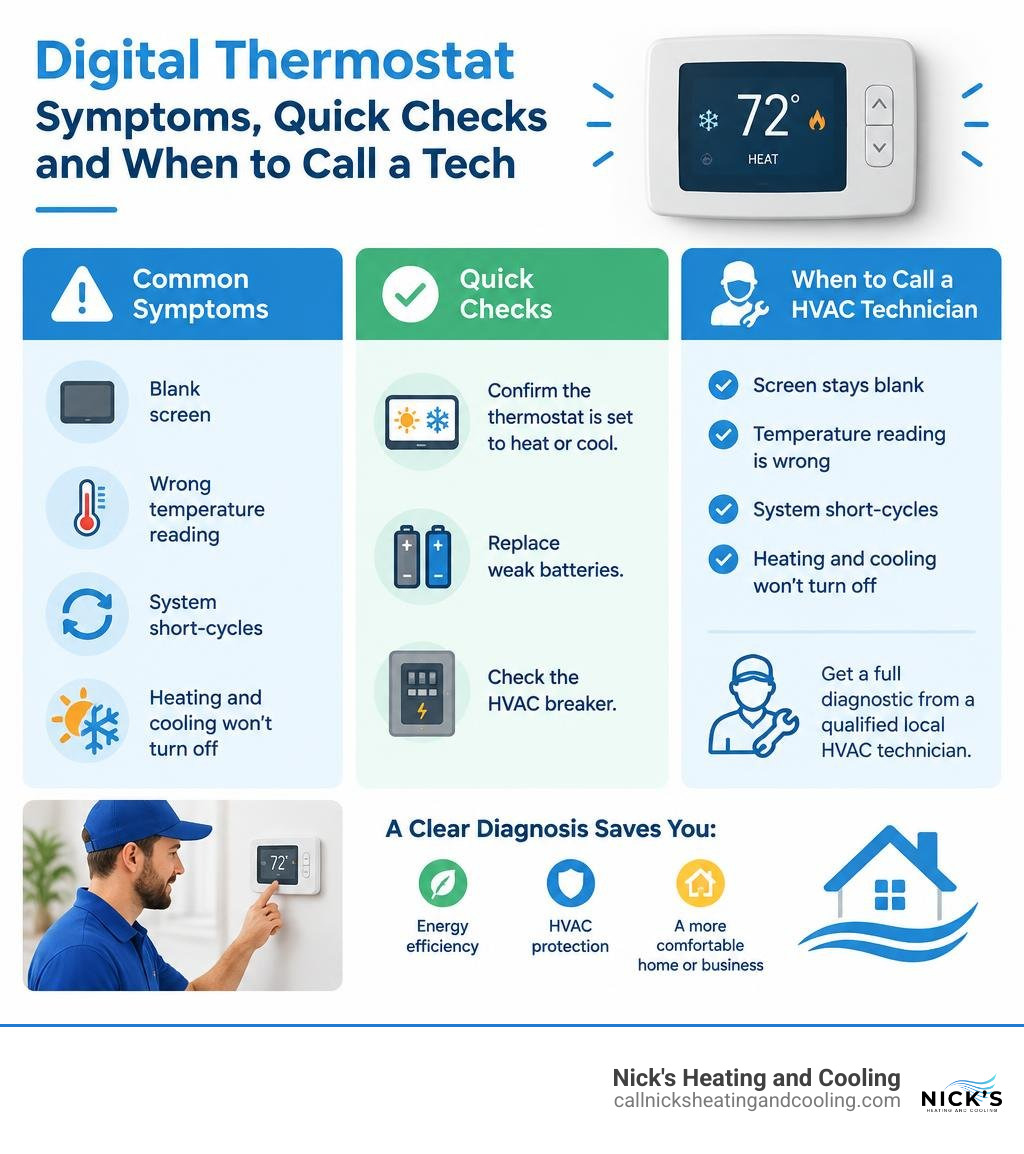
Digital thermostat repair near me word roundup:
Warning Signs Your Digital Thermostat Needs Professional Repair
Your thermostat acts as the brain of your entire heating and air conditioning setup. When that brain experiences a glitch, the rest of your system struggles to keep up. In my years working across Alabama homes, I have seen small control glitches force high-efficiency compressors into early retirement simply because the control interface kept sending conflicting signals.
Recognizing early warning signs prevents minor electrical quirks from spiraling into major mechanical breakdowns:
- Severe Temperature Calibration Mismatches: If you set your thermostat to 72°F on a muggy afternoon, but your indoor thermometer reads 78°F while the air conditioner stays off, your internal temperature thermistor has lost calibration.
- Short-Cycling Equipment: Does your furnace or air conditioning unit turn on for 90 seconds, shut off abruptly, and kick back on three minutes later? This rapid cycling strains electrical contactors and capacitors, often caused by poor anticipator settings or failing digital relays.
- Ghost Temperature Readings: Rapidly jumping ambient temperature displays indicate electrical resistance faults, loose subbase pins, or accumulated internal debris. Learning proper thermostat sensor cleaning and maintenance helps prevent dust build-up from insulating sensitive thermistors.
- Continuous Fan or Compressor Operation: When the blower fan runs endlessly regardless of whether you switch the fan setting from “ON” to “AUTO,” a solid-state relay inside the digital thermostat has likely welded itself closed.
- Unresponsive Touchscreens or Buttons: If pressing your interface produces no tactile beep, no backlight response, and no call for heat or cool, the internal circuit board has sustained hardware degradation.
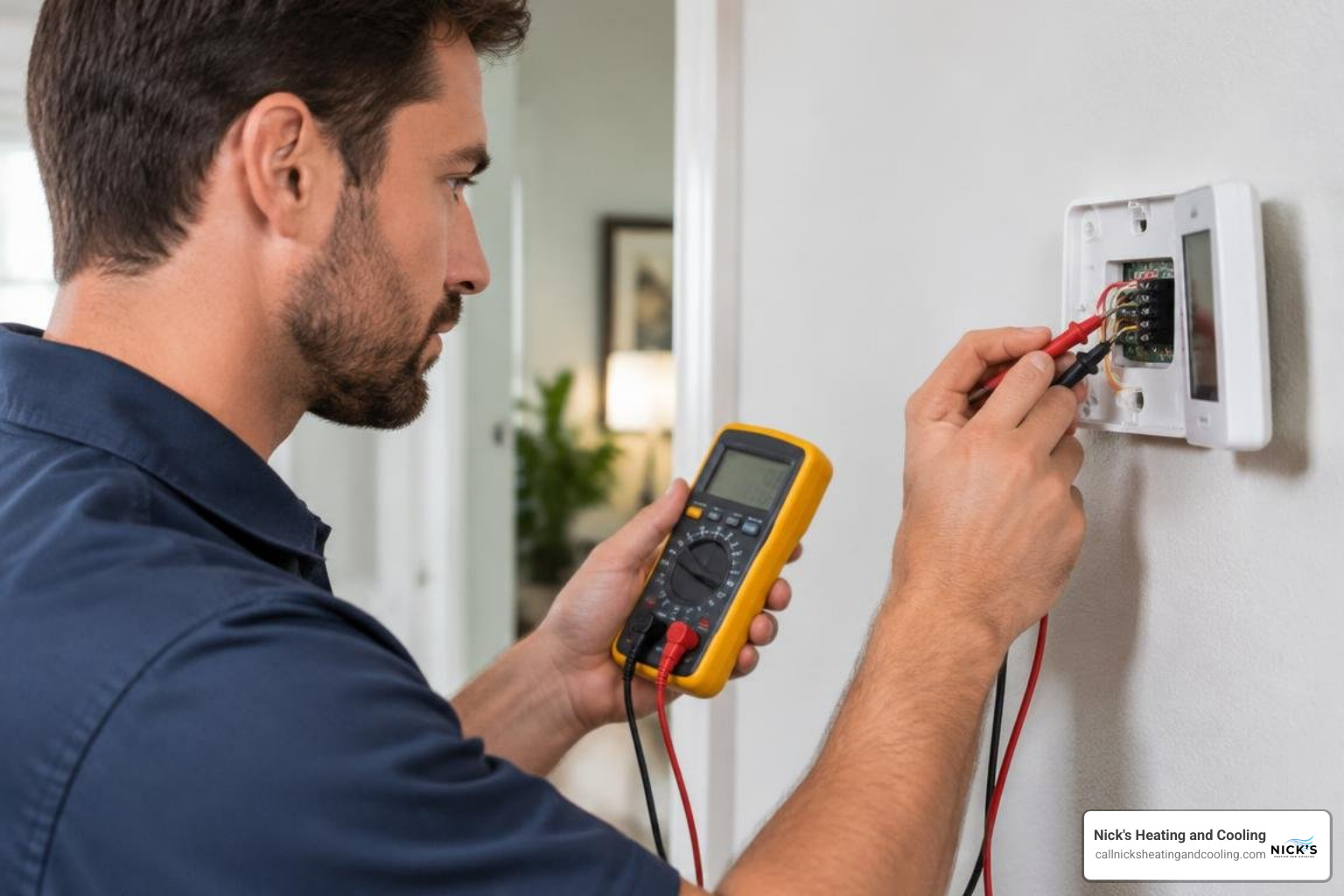
Blank Screen and Power Failure Issues
Walking up to a completely black display screen is frustrating. Before assuming your digital unit is completely dead, let’s explore how power flows to modern wall controls.
Standard programmable and digital units rely on two primary power paths: internal backup batteries (such as AA or AAA alkaline cells) or direct 24-volt alternating current (VAC) supplied through a dedicated “C-wire” (common wire) from your indoor air handler.
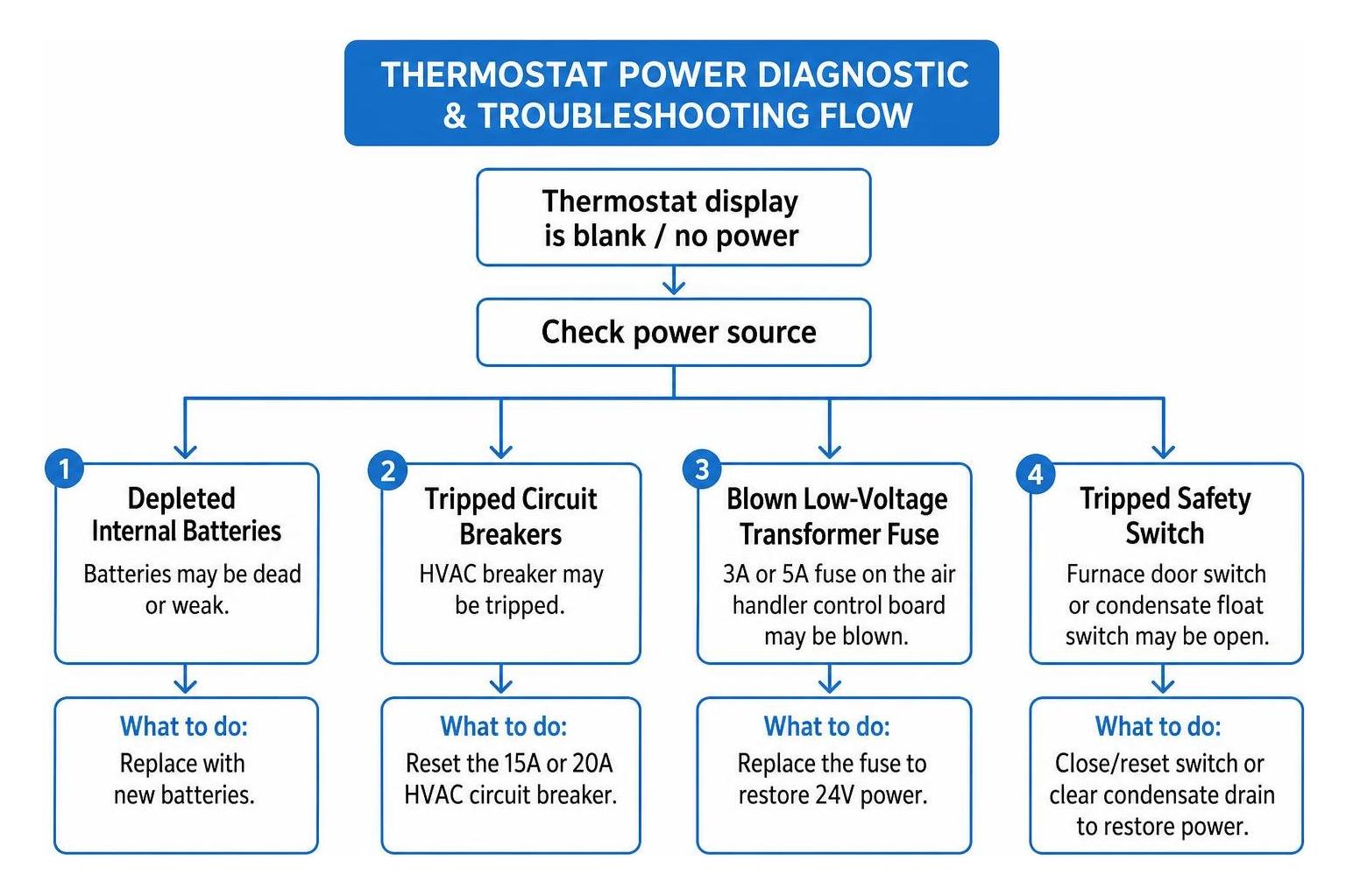
When a display goes dark, the issue often stems from one of the following root causes:
- Depleted Internal Batteries: Many standard digital units use alkaline batteries to retain internal memory and illuminate LCD screens. Swapping these out solves the problem in minutes.
- Tripped Circuit Breakers: A sudden voltage spike can trip the 15-amp or 20-amp HVAC circuit breaker inside your electrical panel, cutting the 120V feed to the transformer.
- Blown Low-Voltage Transformer Fuse: Most modern air handler control boards feature a small 3-amp or 5-amp automotive-style blade fuse. If low-voltage control wires touch or experience a surge, this fuse pops to protect the central transformer, killing power to the wall unit.
- Tripped Furnace Door Safety Switch or Float Switch: Modern central systems include secondary safety mechanisms. If your condensate drain line clogs with algae, the safety float switch opens the 24V circuit, instantly powering down your thermostat to prevent water overflow damage.
Wi-Fi Connectivity and Sensor Communication Errors
Modern smart thermostats rely heavily on constant two-way wireless data. When you notice an offline icon or your mobile app fails to update room conditions, the failure usually traces back to network handshakes or power inconsistencies.
Most digital smart thermostats operate exclusively over 2.4 GHz wireless bands due to their long physical range through drywall and wall studs. If your home router automatically switches connected devices over to a congested 5.0 GHz band, the thermostat drops off the network. Furthermore, firmware updates pushed overnight can occasionally corrupt network credentials, requiring an administrative reboot.
For larger properties utilizing auxiliary temperature monitors in upstairs bedrooms or finished basements, reading our thermostat remote sensor replacement guide will help you identify whether dead coin-cell batteries or RF interference are causing zoning miscommunication between your main display and remote sensors.
Finding Reliable Digital Thermostat Repair Near Me for Quick HVAC Relief
When indoor temperatures climb, you need swift, reliable service. Searching for digital thermostat repair near me shouldn’t result in endless phone tag or vague arrival windows. When your climate control fails, you deserve prompt same-day dispatch from a technician who carries the appropriate diagnostic tools, factory replacement parts, and dedicated voltage meters directly in their service vehicle.
Hiring the certified hvac contractor safeguards your home from unlicensed handymen who might misdiagnose an expensive electronic fault. High-caliber heating and cooling contractors operate with total pricing transparency, offering comprehensive diagnostic evaluations before any repair work begins. For homeowners seeking local solutions, you can easily find an HVAC dealer near me in Hoover, Alabama or connect directly with our local Birmingham field team to restore balance to your indoor climate.
Why Searching for Digital Thermostat Repair Near Me Beats Risky DIY Fixes
With hundreds of online video tutorials claiming that anyone can rewire a wall control in ten minutes, it is tempting to tackle thermostat troubleshooting as a weekend DIY project. However, low-voltage control circuits carry serious risks for expensive heating and cooling equipment.
Consider these common DIY installation pitfalls:
- Fried HVAC Control Boards: The most common DIY mistake is crossing the red power wire (R or Rc) directly with the common wire (C) while the power is live. This direct dead short sends high current through the furnace control board, immediately destroying solid-state components and leading to $400+ in replacement costs.
- Heat Pump Reversing Valve Mix-Ups: Heat pumps utilize an orange or blue (O/B) reversing valve wire to toggle between cooling and heating modes. Misconfiguring this single setting in your digital menus will cause your system to blast hot air when you call for emergency summer cooling.
- Voided Manufacturer Warranties: Leading smart thermostat brands offer robust 5-year manufacturer warranties when installed by certified HVAC professionals, compared to limited 1-to-2 year warranties on self-installed retail models.
If you are currently evaluating budget constraints, learning how to fix thermostat issues on a budget provides practical diagnostic steps you can safely perform on your own without risking expensive system damage.
What to Expect When Booking Digital Thermostat Repair Near Me
When you schedule an appointment with a professional technician, our diagnostic and repair workflow ensures thorough, dependable results:
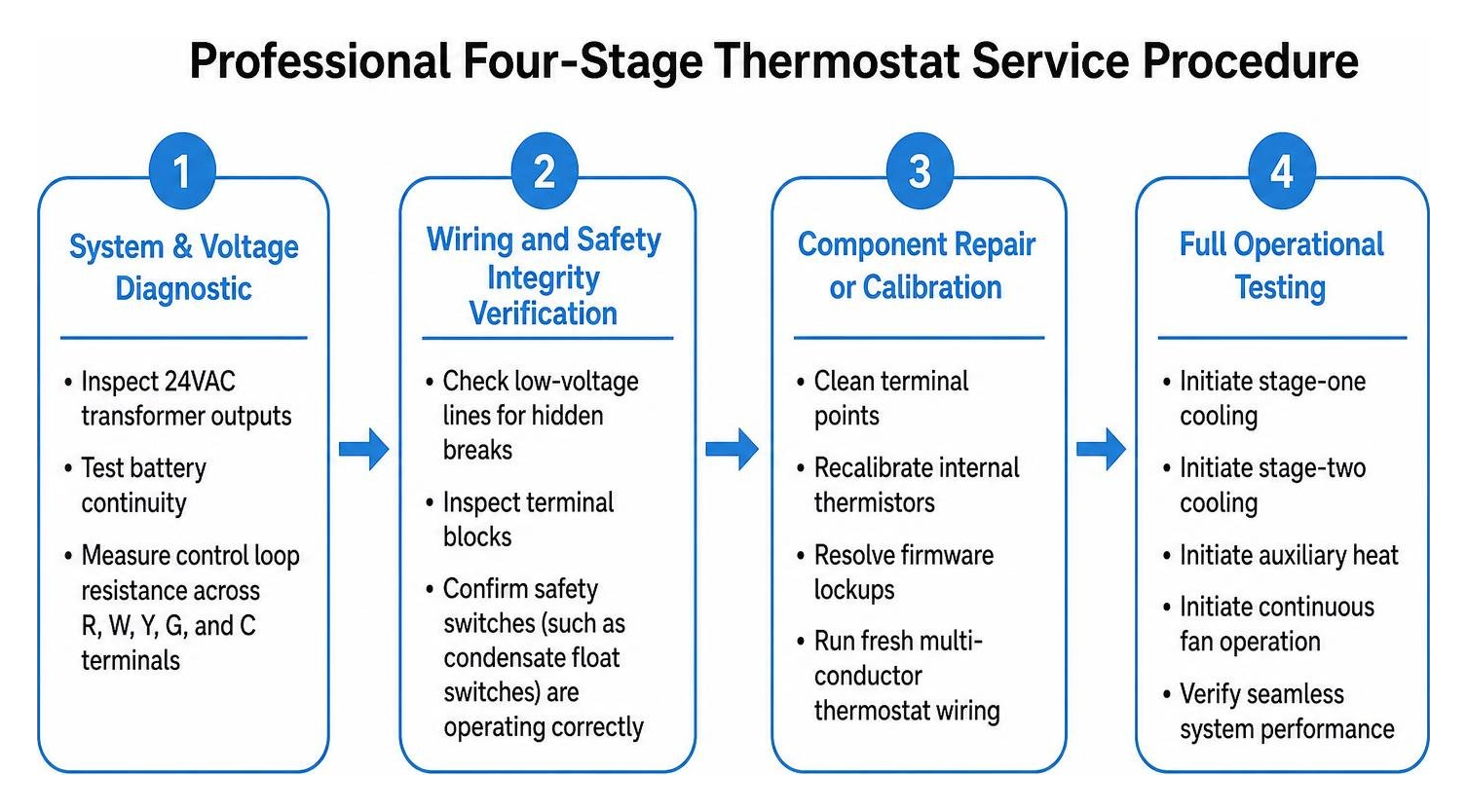
- System & Voltage Diagnostic: The technician inspects 24VAC transformer outputs, tests battery continuity, and measures control loop resistance across R, W, Y, G, and C terminals.
- Wiring and Safety Integrity Verification: We check low-voltage lines for hidden breaks, inspect terminal blocks, and confirm safety switches (such as condensate float switches) are operating correctly.
- Component Repair or Calibration: We clean terminal points, recalibrate internal thermistors, resolve firmware lockups, or run fresh multi-conductor thermostat wiring.
- Full Operational Testing: We initiate calls for stage-one cooling, stage-two cooling, auxiliary heat, and continuous fan operation to ensure seamless integration with our professional ac repair standards.
Most digital thermostat diagnostics and basic component repairs are completed in 30 to 60 minutes, quickly restoring dependable climate control to your home.
Thermostat Types and Brands Serviced Across Modern Homes
Modern residential HVAC systems use a variety of control interfaces. An experienced technician must be familiar with every generation of control hardware:
- Digital Non-Programmable Units: Simple digital displays with basic push-button temperature adjustments. These units utilize solid-state thermistors that provide better reliability than mechanical mercury switches, though they lack automated scheduling.
- Digital Programmable Thermostats: Units featuring 7-day, 5-2 day, or 5-1-1 day programmable schedules. These models help eliminate human error by adjusting setpoints when you leave for work or go to bed.
- Smart Wi-Fi Thermostats: Internet-connected controllers (including Google Nest, Ecobee, Honeywell Home, and Emerson Sensi) that feature machine learning, geofencing, remote smartphone management, and local utility demand-response capabilities.
- Multi-Stage & Dual-Fuel Controllers: Advanced thermostats engineered to manage dual-fuel setups (such as an electric heat pump paired with a natural gas furnace) or multi-stage compressors requiring complex staging algorithms.
Repair vs. Upgrade: When to Replace Your Thermostat
How do you determine whether to repair your existing digital thermostat or upgrade to modern equipment? Use this simple rule of thumb:
If your thermostat is under 7 years old, shows no physical display damage, and simply suffers from loose terminal wiring, a dirty sensor, or blown low-voltage fuses, a standard repair is your most cost-effective choice.
However, replacement is the smarter investment if:
- The Unit Is Over 10 Years Old: Digital microprocessors and solid-state relays degrade over time, leading to frequent sensor drift and erratic system cycling.
- You Are Missing a Dedicated C-Wire: Upgrading your thermostat wiring provides steady power without relying on “power stealing” tricks that can damage HVAC relays.
- You Want Measurable Energy Savings: Smart thermostats can reduce annual heating and cooling energy consumption by an average of 15% to 20%. In fact, an energy audit showed a real-world customer who saw an 18% reduction in their power bill simply by switching to an Ecobee smart controller.
- You Want Utility Rebates: Local power utilities regularly offer instant equipment rebates ranging from $50 to $100 when you install an Energy Star-certified smart thermostat.
Understanding Digital Thermostat Repair Costs and Pricing Factors
Thermostat repair pricing depends on the nature of the electrical issue, the accessibility of your low-voltage wiring, and the specific brand of your wall control.
Nationally, most thermostat repairs cost between $114 and $316, with the national average sitting at $213. Simple wiring repairs and fuse replacements fall on the lower end of the spectrum, while complex digital microprocessor failures or pulling new 18/8 thermostat wire through finished interior walls require additional labor.
| Service Type | Typical Cost Range | What Is Included in the Service |
|---|---|---|
| Minor Electrical & Wiring Fixes | $100 – $150 | Subbase rewiring, terminal cleaning, replacing 3A/5A board fuses, and battery terminal repair. |
| Component Repair & Recalibration | $150 – $250 | Replacing remote room sensors, board recalibration, C-wire power adapters, and safety circuit fixes. |
| Basic Digital Thermostat Replacement | $200 – $300 | Supplying a digital programmable unit, mounting, full system wiring, and operational run-testing. |
| Premium Smart Thermostat Upgrade | $300 – $500+ | Supplying and installing high-end hardware (e.g., Nest Learning or Ecobee Smart Thermostat Premium), establishing dedicated 24V C-wire, Wi-Fi pairing, and smart app configuration. |
If a malfunctioning thermostat causes your compressor to run continuously or freeze up its indoor evaporator coils, you may require comprehensive ac repair to restore proper system refrigerant pressure and airflow.
Frequently Asked Questions About Digital Thermostat Repair
How long does a typical thermostat repair take?
A professional digital thermostat repair typically takes between 30 and 60 minutes. When a certified technician arrives at your home, diagnosing the underlying issue—whether checking low-voltage transformers, testing for open circuits, or verifying safety switches—usually takes about 15 minutes.
Simple component replacements, firmware resets, or terminal repairs take another 15 to 30 minutes. If your home lacks a dedicated common wire and requires pulling a new multi-conductor wire through the wall cavity or adding a continuous power adapter, the process may take 60 to 90 minutes.
What causes a digital thermostat to suddenly lose Wi-Fi connectivity?
Smart thermostats typically lose their internet connection due to one of four common issues:
- Network Frequency Mismatches: Dual-band home routers often combine 2.4 GHz and 5.0 GHz signals under one network name. If the router forces the thermostat onto the 5.0 GHz band, the connection drops.
- Low Operating Voltage: Thermostats running on “power stealing” setups without a dedicated C-wire may power down their Wi-Fi chip whenever the battery drops below 3.6 volts.
- Firmware and Cloud Server Updates: Router security changes or automated manufacturer updates can interrupt server handshakes, requiring a simple network reset.
- Weak Signal Strength: If your thermostat is separated from the router by thick plaster, metal ductwork, or brick walls, signal degradation can cause frequent disconnects.
Can a malfunctioning thermostat cause high electric bills?
Yes. A malfunctioning digital thermostat is a common cause of sudden spikes in monthly utility bills. When an internal temperature sensor loses calibration by even 3°F or 4°F, it can force your air conditioner or heating system to run far longer than necessary.
Furthermore, if a relay sticks, it can cause the outdoor compressor to short-cycle continuously—drawing high startup electrical surges multiple times per hour. In heat pump systems, a faulty thermostat can accidentally energize expensive auxiliary electric resistance heat strips during mild weather, increasing power consumption.
Conclusion
A dependable digital thermostat keeps your home comfortable and your energy bills under control. Whether you are dealing with a blank screen on a humid summer afternoon, frustrating Wi-Fi disconnects, or uneven room temperatures, you do not have to tackle complex electrical diagnostics alone. Nick’s Heating and Cooling provides certified HVAC technicians, free no-obligation system inspections, and fast diagnostic services to get your climate control running smoothly again.
When you need reliable comfort solutions, schedule professional thermostat repair and HVAC services with our local team.
Nick’s Heating and Cooling currently services Birmingham, Hoover, Vestavia Hills, Mountain Brook, Alabaster, Chelsea, Homewood, Trussville, Pelham, and Irondale for all your HVAC and Heating needs.